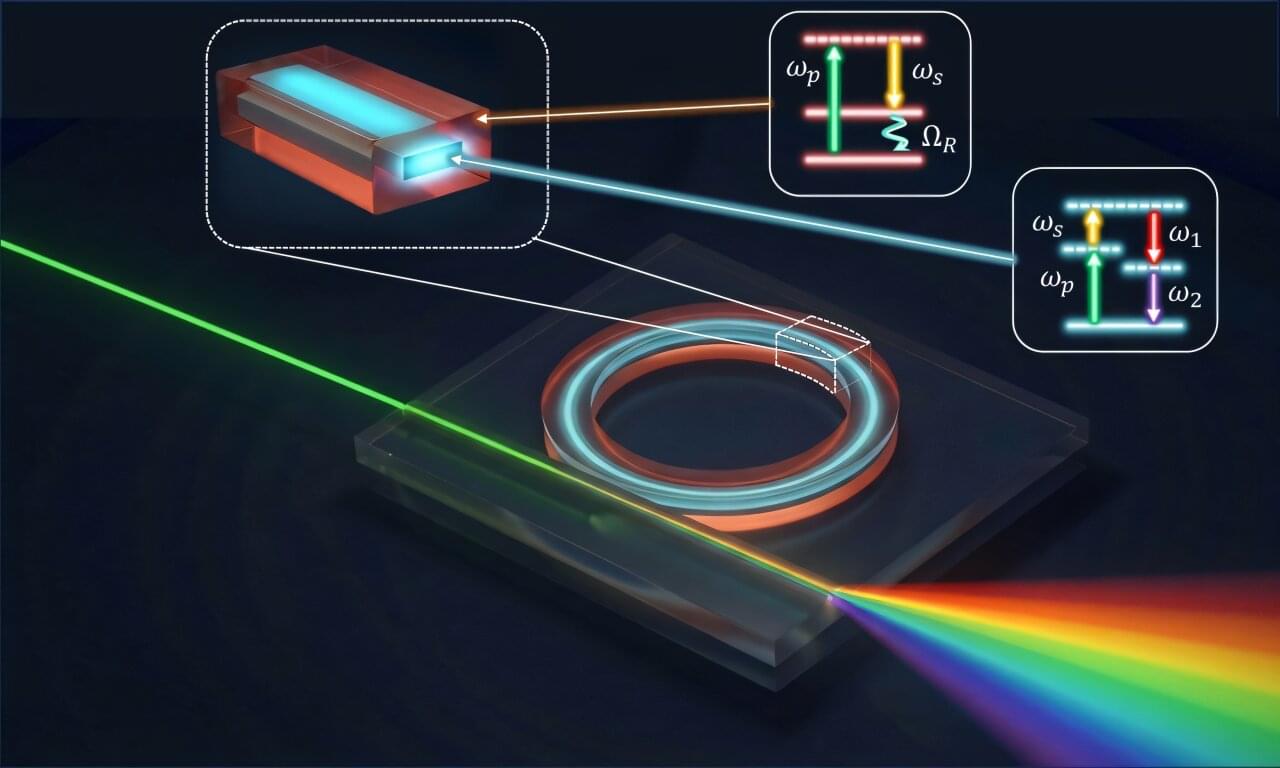
Modern photonic chips can pack sophisticated optical functions onto devices smaller than a fingernail. They are increasingly used to generate, manipulate and measure light for applications ranging from communications to sensing. But most of these chips rely on a single material to do the heavy lifting, limiting the range of optical effects they can produce.
Researchers have now demonstrated a different approach: letting two materials share the work. As reported in Advanced Photonics, scientists combined two nonlinear optical effects that normally occur separately. Their device uses a silicon nitride core to generate optical frequency combs while a surrounding silica layer produces Raman scattering.
By harnessing the strengths of both materials at once, the team created a new type of integrated photonic device capable of generating broad ranges of light frequencies on a chip.