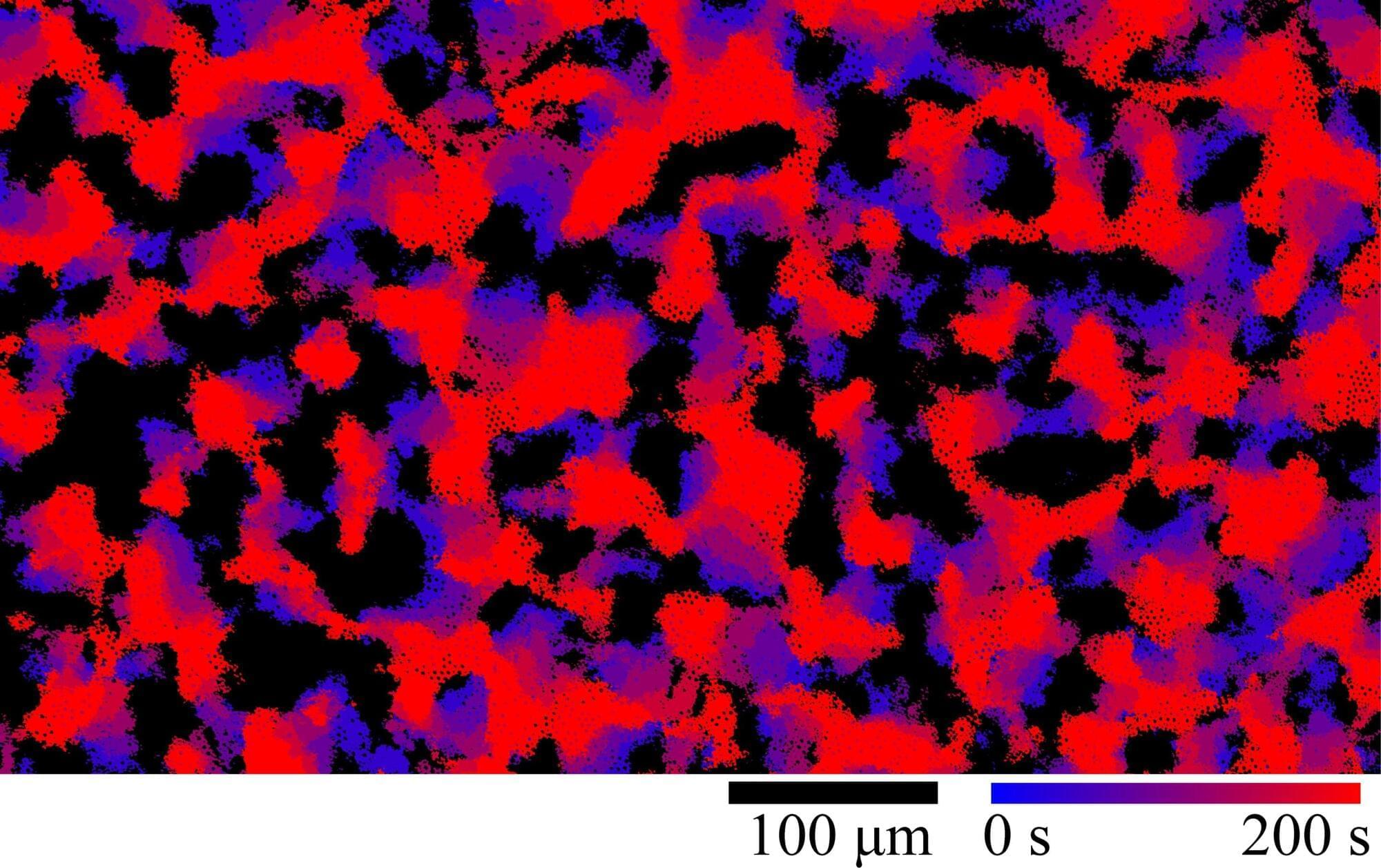
From schools of fish and flocks of birds to microscopic synthetic particles, many systems in nature and the laboratory consist of individual units or agents that move by consuming energy. These systems are known as active matter because their components continuously use energy to generate motion, either individually or through interactions with their environment.
Inspired by such systems, researchers have become increasingly interested in nonreciprocal interactions, in which the influence one particle exerts on another is not equally returned. In other words, one particle can affect another more strongly than it is affected in return, effectively breaking action-reaction symmetry. This is surprising because, under Newton’s third law, passive particles cannot continuously push one another in the same direction.
In this system, however, nonequilibrium electrohydrodynamic flows allow one particle to effectively “chase” another, so activity emerges even though the particles themselves are not self-propelled. Such asymmetry can generate entirely new forms of collective motion and self-organization. However, experimental realizations have largely been limited to small particle clusters.