Superconductors are materials that carry electrical current with zero resistance below a specific critical temperature. In conventional superconductors, the transition to superconductivity generally occurs at very low temperatures.
Some unconventional superconductors, however, enter their superconducting phase at comparatively higher critical temperatures. This could be advantageous for practical applications, as superconductivity at higher temperatures could reduce the need for complex and expensive cooling systems. However, these materials generally still require substantial cooling.
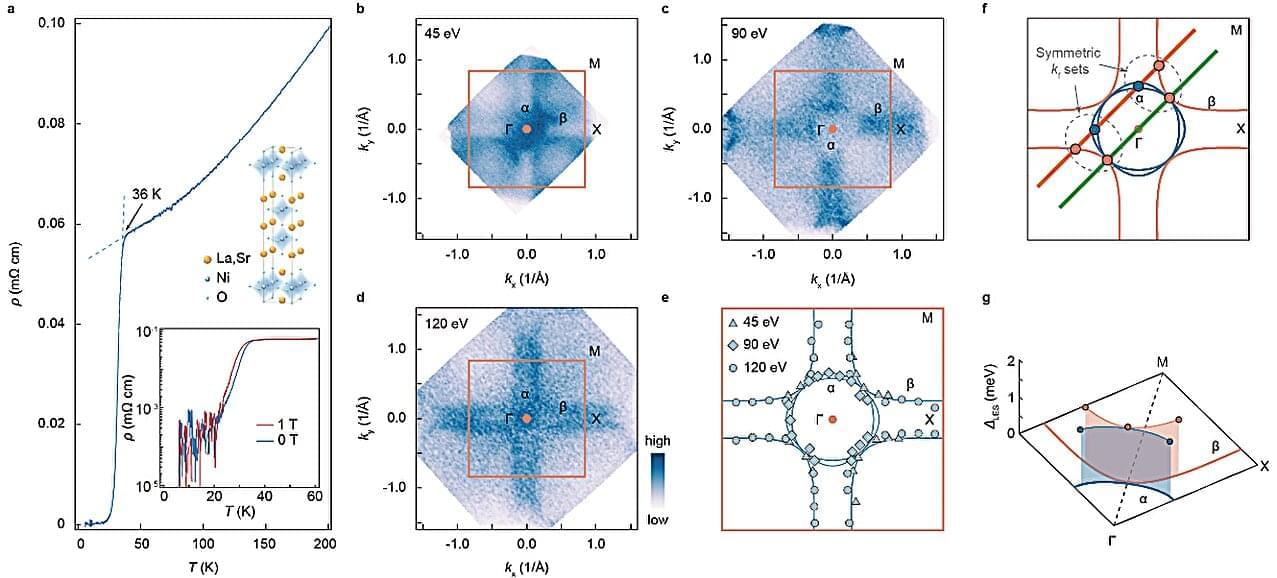
Researchers at Nanjing University, the University of Science and Technology of China, the Hong Kong Polytechnic University and other institutes in China recently investigated the electronic processes underpinning superconductivity in La₃Ni₂O₇, a nickelate that has exhibited superconductivity at temperatures of up to around 80 K (−193°C, −316°F) under very high pressure.