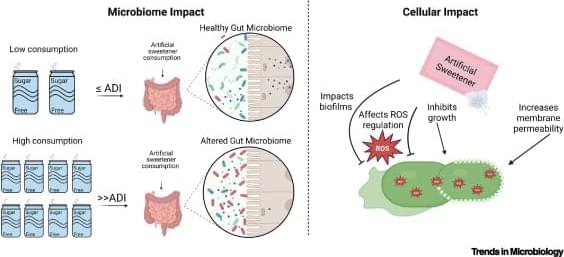
Artificial sweeteners are non-nutritive compounds that have a profound sweetening effect with a negligible to zero calorific contribution. Global initiatives to reduce sugar consumption to tackle health conditions such as obesity have led to a significant increase in their consumption in recent decades. Artificial sweeteners have undergone extensive testing to determine whether their consumption could impact human health; however, their impact on the microbiome and microbial physiology has been comparatively overlooked. Recent work has demonstrated that artificial sweeteners (e.g., Ace-K, saccharin, and aspartame) can influence the oral and gut microbiome and that they can significantly affect bacterial behavior and growth. In this review, we will contextualize these findings and explore their relevance to human artificial sweetener consumption.