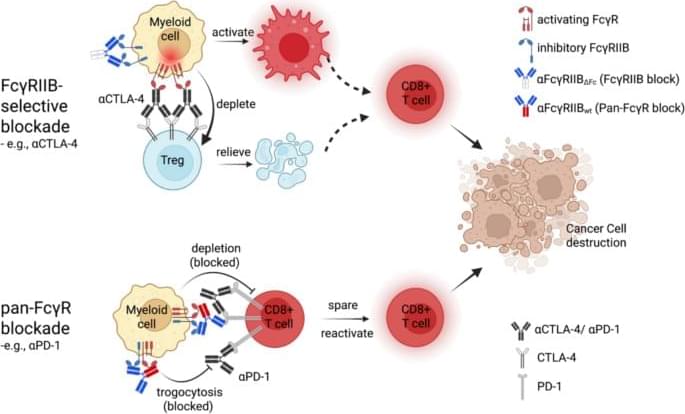
Fc-gamma receptors (FcγRs) regulate IgG antibody activity, and Fc-engineering is a proven method to improve the efficacy of tumor-targeting antibodies. Here, we explore tailored FcγR blockade to enhance the therapeutic efficacy and tolerability of immune checkpoint-blocking (ICB) antibodies.
Mechanistically matched murine surrogate and human lead FcγR-blocking and immune checkpoint-blocking antibodies were used to study whether tailored FcγR-blockade, targeting FcγRIIB selectively or all FcγRs, can enhance the efficacy and overcome resistance to immune checkpoint therapy in vivo and in vitro. Mechanistic studies were performed with clinical reagents, including ipilimumab, nivolumab, pembrolizumab, and human FcγRIIB-selective (BI-1607) and pan-FcγR-blocking (BI-1206) antibodies, using human cells and transgenic animals with clinically relevant expression of immune checkpoint receptors.
We demonstrate that FcγRIIB-selective and pan-FcγR-blocking antibodies increase the in vivo efficacy of αCTLA-4 and αPD-1 antibodies, respectively. FcγRIIB-selective antibody enhancement of αCTLA-4 was associated with increased intratumoral Treg depletion, myeloid reprogramming, interferon-γ and CXCL10-induction, and increased activated effector CD8+ T cells, correlating with higher activating-to-inhibitory (A: I) FcγR engagement ratios. Conversely, pan-FcγR blockade protected αPD-1-coated T cells from macrophage phagocytosis, increasing intratumoral activated CD8+ T cells by decreasing activating and inhibitory FcγRs.