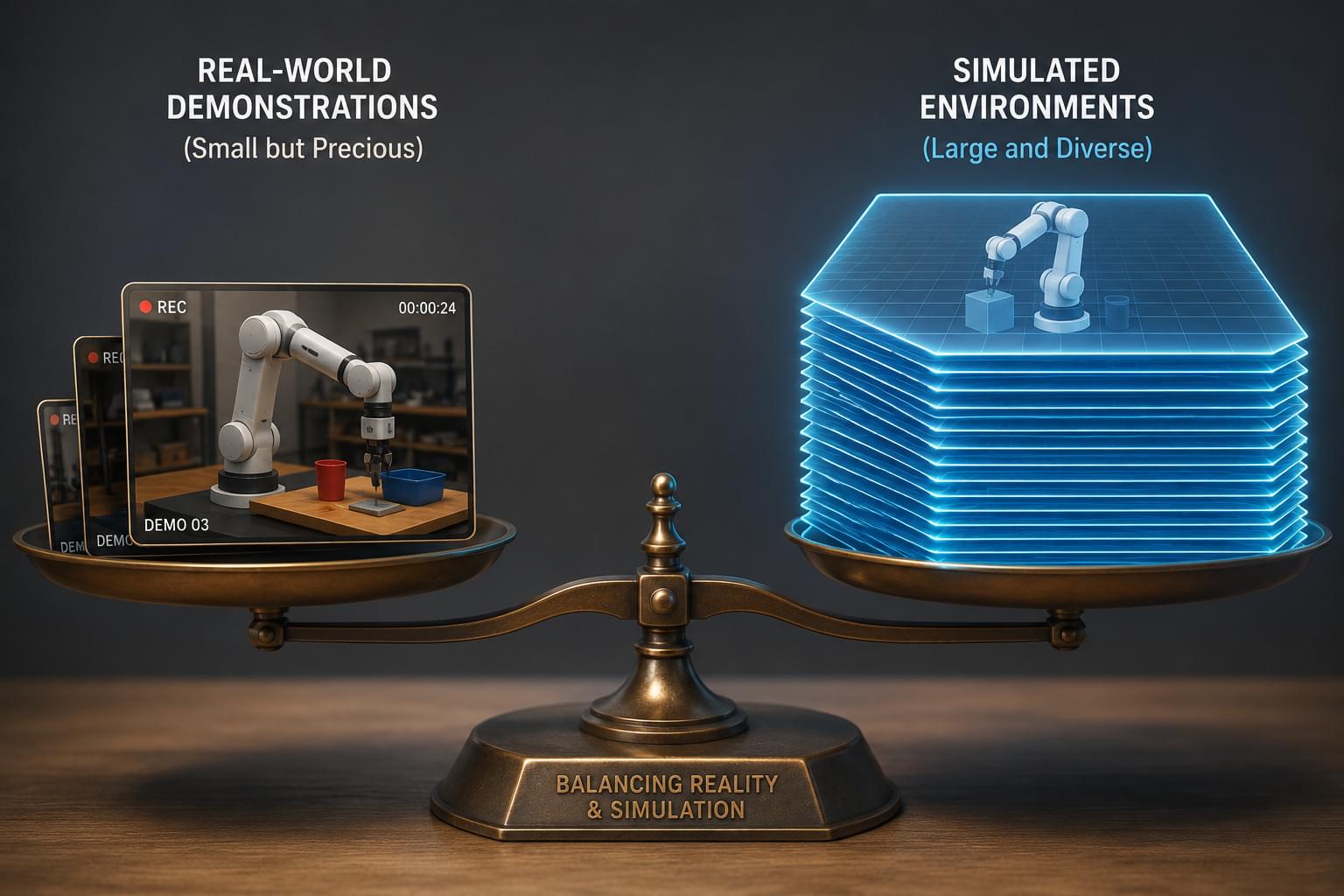
Research teams at Carnegie Mellon and Stanford independently found that vision-language-action robot policies trained on just 40% synthetic data matched the performance of policies trained on 100% real-world demonstrations. That result undercuts the assumption behind billions in robotics funding: that owning a massive real-world data collection fleet is the primary competitive moat.
Synthetic robot training data just cleared a bar that changes how robotics companies should be valued. Robots face a real data shortage: the physical world has produced only about 500,000 hours of high-quality robotic interaction data, while achieving baseline generalization in embodied AI is estimated to require between 1 billion and 10 billion hours, according to a 2026 industry analysis published via ANTARA. That gap is exactly why the CMU and Stanford finding matters.
Teams at CMU and Stanford independently reported 2026 results where vision-language-action models trained on 40% synthetic data matched policies trained on 100% real data on held-out tasks, according to the State of Robotics 2026 report from the Robotics Center of Silicon Valley. That finding runs against the scaling narrative borrowed from language models, where bigger and more real data has generally meant better performance. In robotics, synthetic robot training data closed most of that gap at less than half the real-world volume.