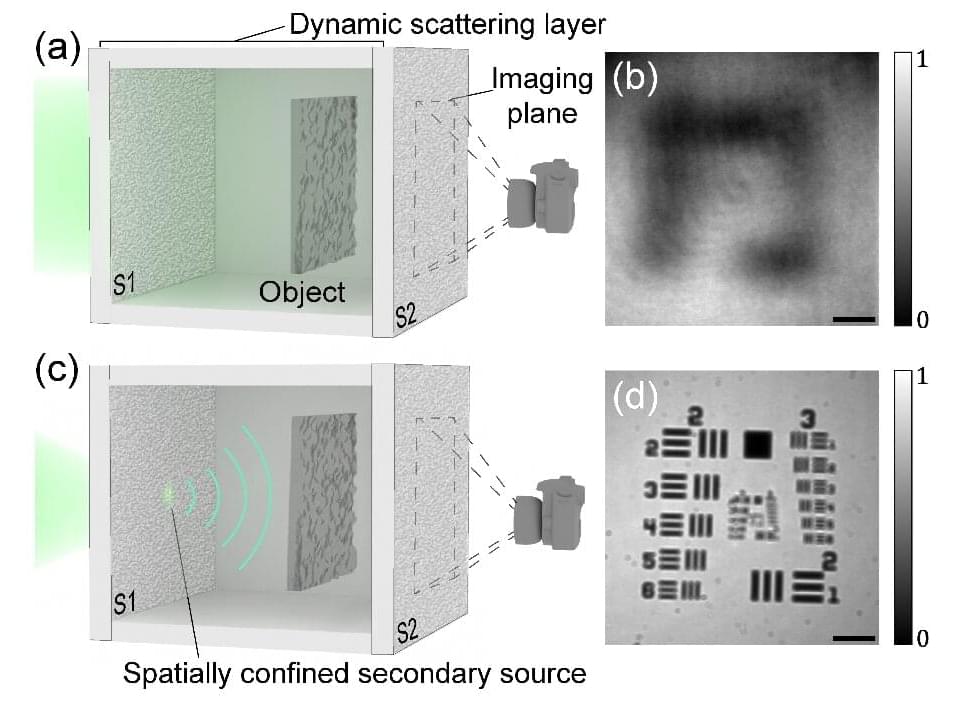
A KAIST research team led by professor Mooseok Jang from the Department of Bio and Brain Engineering has developed a single-shot phase imaging technique that reconstructs a phase object—a transparent object such as glass, plastic film or a living cell, which produces almost no visible contrast under an ordinary camera but induces a subtle shift in light called a phase change—from a single measurement, even when the object is fully enclosed between two dynamic scattering layers.
The findings are published in the journal Optica.
Phase objects are difficult to see with conventional cameras because they show little brightness contrast with their surroundings. However, analyzing the minute phase shift can reveal an object’s morphology and optical thickness and can be used to determine its physical thickness or refractive index variation when the other quantity is known. For this reason, phase imaging is widely used to observe living cells without staining and to inspect transparent components in semiconductors and displays.