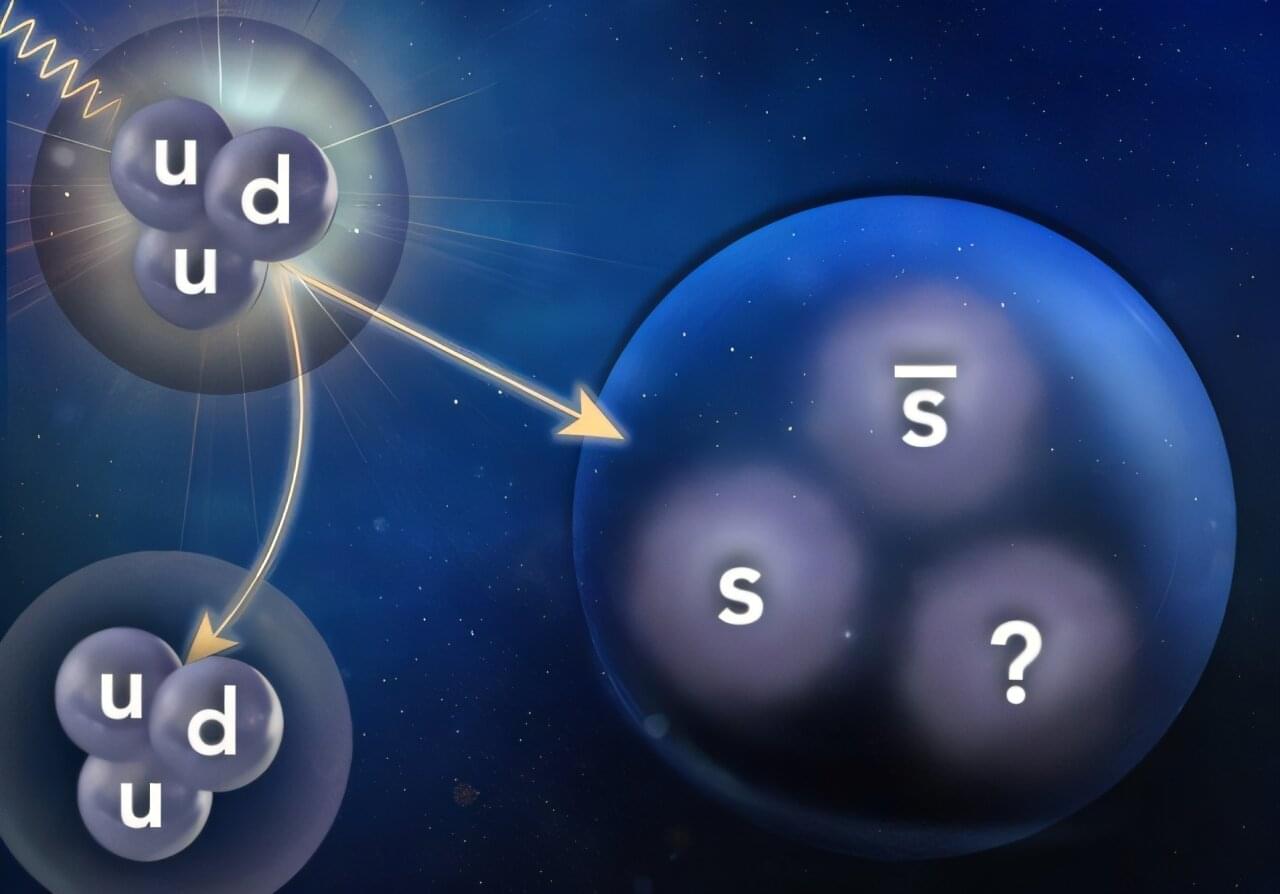
Despite science’s best efforts to classify the vast menagerie of subatomic particles discovered over the past few decades, some exotic varieties defy explanation. Now, nuclear physicists at the U.S. Department of Energy’s Thomas Jefferson National Accelerator Facility have found evidence of two unexpected structures that could help better sort the zoo of exotic particles.
These structures may provide new insights into a perplexing family of objects known as XYZ states don’t fit cleanly into the prevailing model of particles made of quarks, the elementary building blocks of nature, and, for the first time, researchers at Jefferson Lab observed two such signals produced by a beam of high-energy photons interacting with a proton target.
The results, reported by the Gluonic Excitations (GlueX) Collaboration in Experimental Hall D at Jefferson Lab, were recently published in the journal Physical Review Letters and could go a long way in unraveling how one of the universe’s fundamental forces plays a role in the formation of matter.