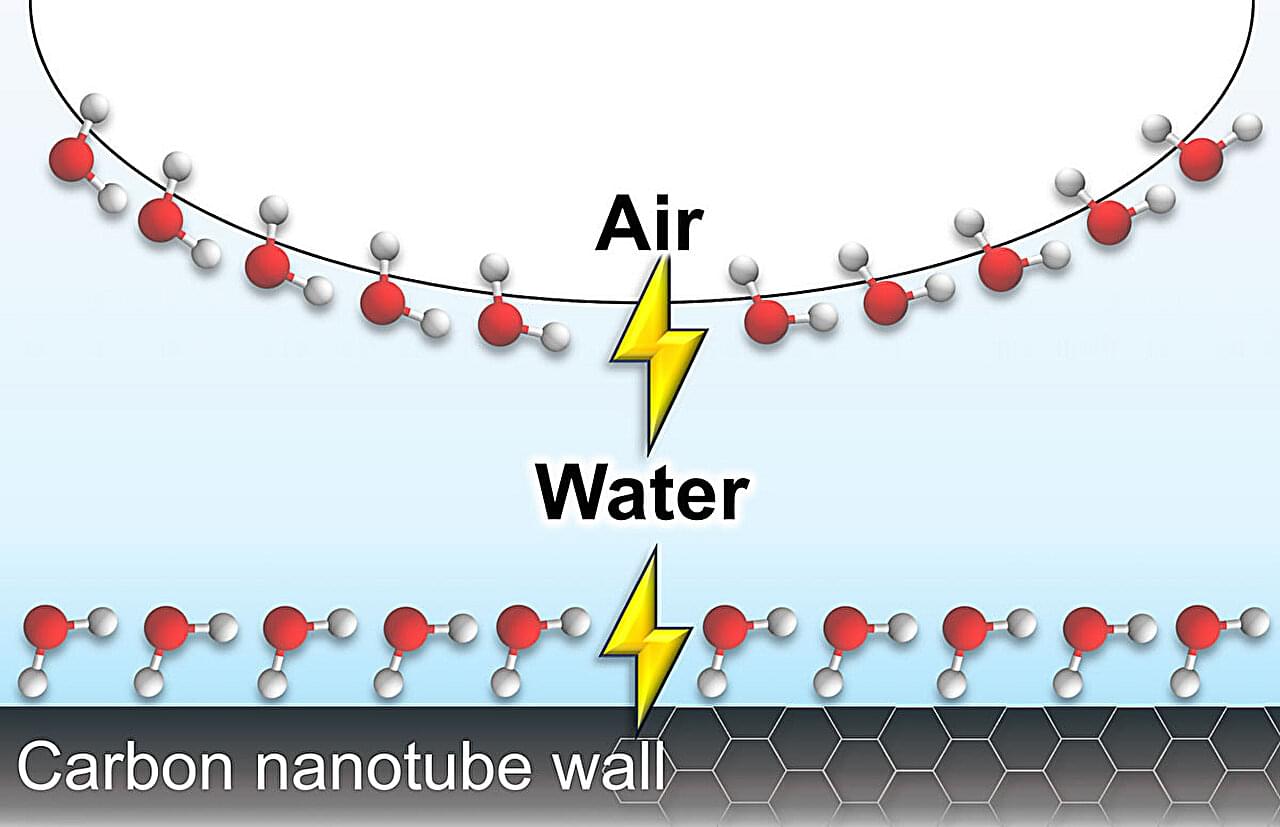
Bubbles are round, and we know surface tension does that. But squeeze that gas-liquid boundary into a space only a few tens of nanometers wide—could other forces be at work?
Now, an international team from Kyushu University, Nankai University, Stanford University and the University of Alberta has taken a direct look. Publishing on July 14 in the Journal of the American Chemical Society, they combined three-dimensional transmission electron microscopy (3D TEM) with force analysis to provide evidence for a powerful electric field at nanoconfined air-water interfaces.
“Water looks simple, but it’s actually incredibly complex,” says Qin-Yi Li, associate professor at Kyushu University’s Faculty of Engineering. “Its structure is especially rich at the water-air interface, and it shifts dramatically with scale.”