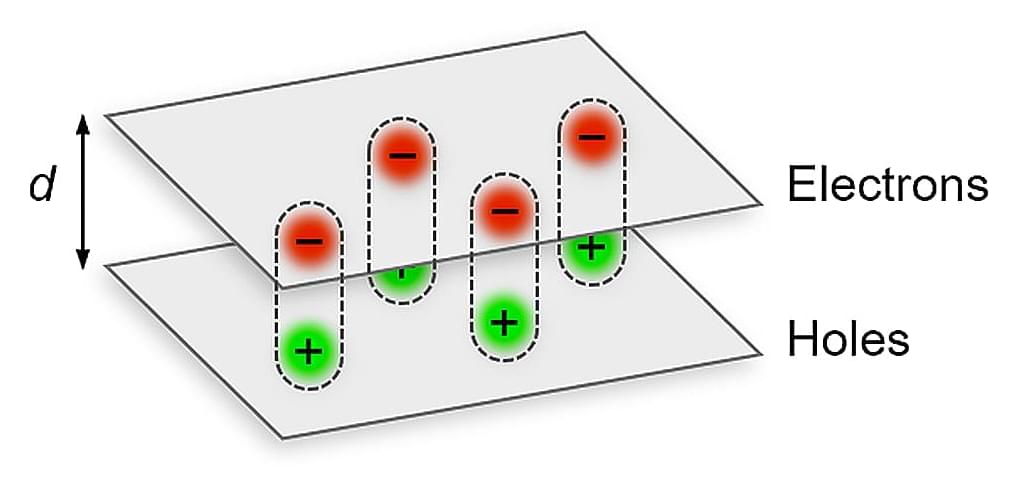
Bose-Einstein Condensates (BECs) are often described as a “fifth state of matter”: a quantum state in which many particles lose their individual identities and behave as one collective object. For more than 60 years, researchers have sought to create such condensates from excitons — electron-hole pairs — as a solid-state route to macroscopic quantum coherence, which is useful for quantum technologies. This has been difficult to realize in controllable semiconductor devices because optically generated excitons have very short lifespans of around a billionth of a second, and BECs are normally attained with supercold gasses in a vacuum.
But now, a team led by Lawrence Berkeley National Laboratory (Berkeley Lab) has observed a tunable BEC of excitons at high temperature in an atomically thin semiconductor. The findings, published in Nature, reveal not only that the excitons form a BEC, but also that the condensate has an internal structure that can be switched by a magnetic field.