“Science is a conversation,” said John Katsaras, neutron scattering scientist at ORNL’s Spallation Neutron Source, a Department of Energy Office of Science user facility. “Many years ago, Pat [Collier] and I wanted to see what would happen when we combined our scientific interests. He wanted to explore soft matter systems for neuromorphic computing [computing systems designed to mimic how the brain processes information], and I’ve studied the structure and dynamics of lipid membranes over the past 40 years. We are now applying decades of our soft matter experience to a problem neither one of us would have imagined pursuing five years ago.”
Soft matter includes materials that readily change shape, such as membranes, gels and polymers. Although biological membranes vary in complexity, they all share a common foundation: a lipid bilayer, or double layer of molecules. Each lipid contains a hydrophilic (water-attracting) head and a hydrophobic (water-repelling) tail.
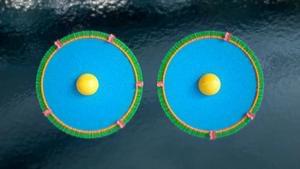
To study membrane properties under electrical stimulation, Katsaras and Collier used water droplets suspended in oil, known as a droplet interface bilayer. These early experiments showed unexpected electrical data, prompting them to shift their attention to membranes surrounding neurons, where many memory and learning processes occur.