Most glues need a dry surface to stick properly. Bonding materials underwater is challenging because water forms a thin film on any surface, so instead of an adhesive touching a material directly, it touches a layer of water, which weakens the bond. But scientists from China have now created a superglue that repels water and forms a strong, recyclable bond within seconds, as they report in a paper published in Nature Communications.
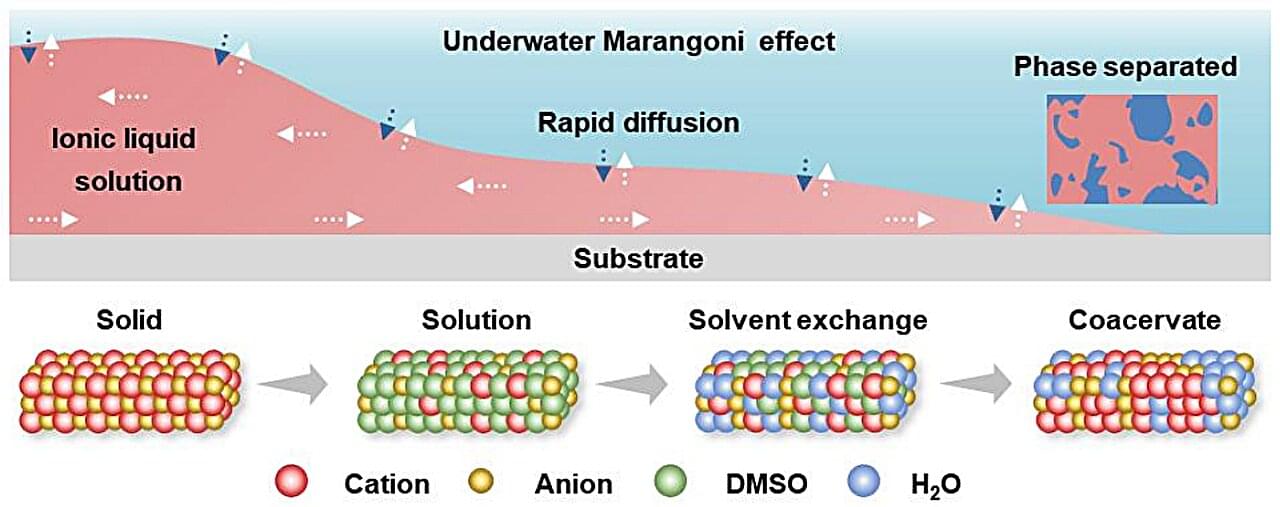
To make their glue, the research team synthesized a supramolecular ionic liquid, a salt-like material whose molecules are held together by temporary, reversible interactions. They mixed it with a solvent called dimethyl sulfoxide (DMSO) and applied the solution directly onto submerged objects made of ceramic, copper, epoxy resin and polyamide.
When the mixture hits the underwater surface, differences in surface tension trigger a rapid motion called Marangoni flow that disrupts the thin layer of water on the surface. The DMSO solvent then diffuses outward, causing the molecules to reassemble into a tough, water-resistant adhesive within seconds.