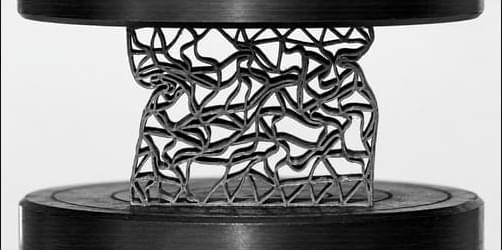
Simulations reveal disordered structures that are also surprisingly resistant to impacts and cracks.
Metamaterials derive their unique properties from their tailored, macroscale structures, not from their chemical compositions or atomic-scale structures. Although designers often rely on regular, repeating architectures, many of nature’s toughest materials—from bone to spider silk—owe their resilience to structural disorder. Now, inspired by those biological examples, researchers have used machine learning to find new designs for disordered metamaterials [1]. These structures not only have the properties for which they were optimized, but they also resist deformation and fracture. The researchers have built a prototype car bumper based on their designs, and they propose uses in ballistic shields, helmets, and other protective equipment.
The design of functional metamaterials has conventionally focused on ordered structures, where the repeating nature of the patterns allows predictions of macroscopic behavior. Amorphous structures lack that periodicity, leaving an enormous number of possible disordered arrangements that are difficult to explore systematically. Yet disorder can also be an asset, enabling mechanical behaviors that are otherwise difficult or impossible to achieve. The main challenge has been to search the large number of potential structures efficiently enough to identify the rare ones that combine useful functionality with physical stability.