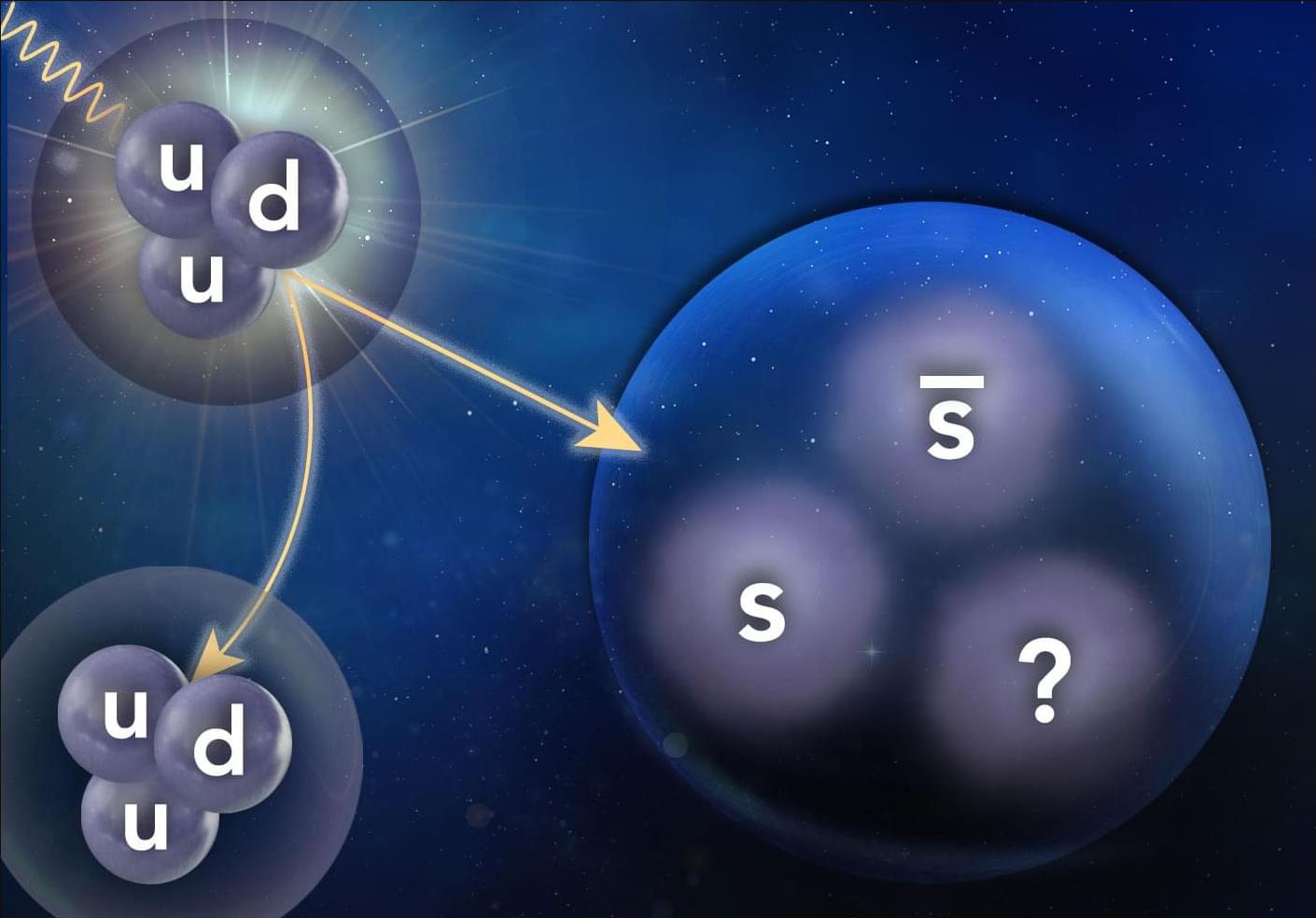
A first attempt to produce a mysterious strangeonium state using a photon beam yielded important and unexpected results.
Physicists have spent decades trying to organize the growing collection of subatomic particles, yet some of the most unusual discoveries still resist simple classification. At the U.S. Department of Energy’s Thomas Jefferson National Accelerator Facility, researchers have now detected evidence for two unexpected structures that could help clarify this increasingly complicated landscape.
The signals may shed light on a puzzling class of particles called XYZ states. These objects do not fit comfortably within the conventional picture of particles built from quarks, the elementary constituents of matter. For the first time at Jefferson Lab, two such signals were observed when a beam of high-energy photons struck a proton target.