As well as T cells bearing an engineered TCR55-A50E, which forms catch-bonds with both HIVpol/B∗35 pMHC and Pep20/B∗35 pMHC. We treated TCR55 and TCR55-A50E cells with pMHC-eVLPs pseudotyped with either HIV/B∗35 or Pep20/B∗35 and subsequently assessed T cell activation by CD69 upregulation and eVLP transduction. Consistent with previous reports, we observed increased CD69 upregulation in TCR55 cells by Pep20/B∗35 eVLPs compared to HIV/B∗35 eVLPs, whereas TCR55-A50E cells were similarly activated by both pMHC-eVLPs (Figure S4G). Notably, pMHC-eVLPs presenting HIV/B∗35 were still able to induce CD69 upregulation on TCR55 cells despite reported slip-bond formation (Figure S4G). Interestingly, both HIV/B∗35 and Pep20/B∗35 pMHC-eVLPs were able to efficiently transduce both TCR55 and TCR55-A50E cells (Figure S4H), suggesting that antigen specificity and physiological TCR·pMHC affinity, rather than catch-bond formation, are the primary determinants of pMHC-eVLP-mediated T cell activation and transduction.
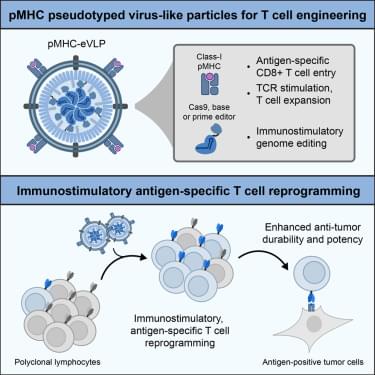
Collectively, these findings demonstrate that the pMHC-eVLP platform can be programmed with different antigens and HLA allotypes to enable selective and efficient targeting of tumor-specific T cells via natural TCRs with physiological antigen affinities, and that pMHC-eVLPs induce antigen-specific T cell activation during TCR-mediated entry.