Efficiently controlling heat generation has become a major challenge as the semiconductors used in smartphones, computers and similar devices have become higher-performing and more miniaturized. The way heat is transmitted is determined by the vibration of the atoms that constitute a material, but it is not easy to directly examine, at the atomic scale, how neighboring atoms vibrate in coordination with one another.
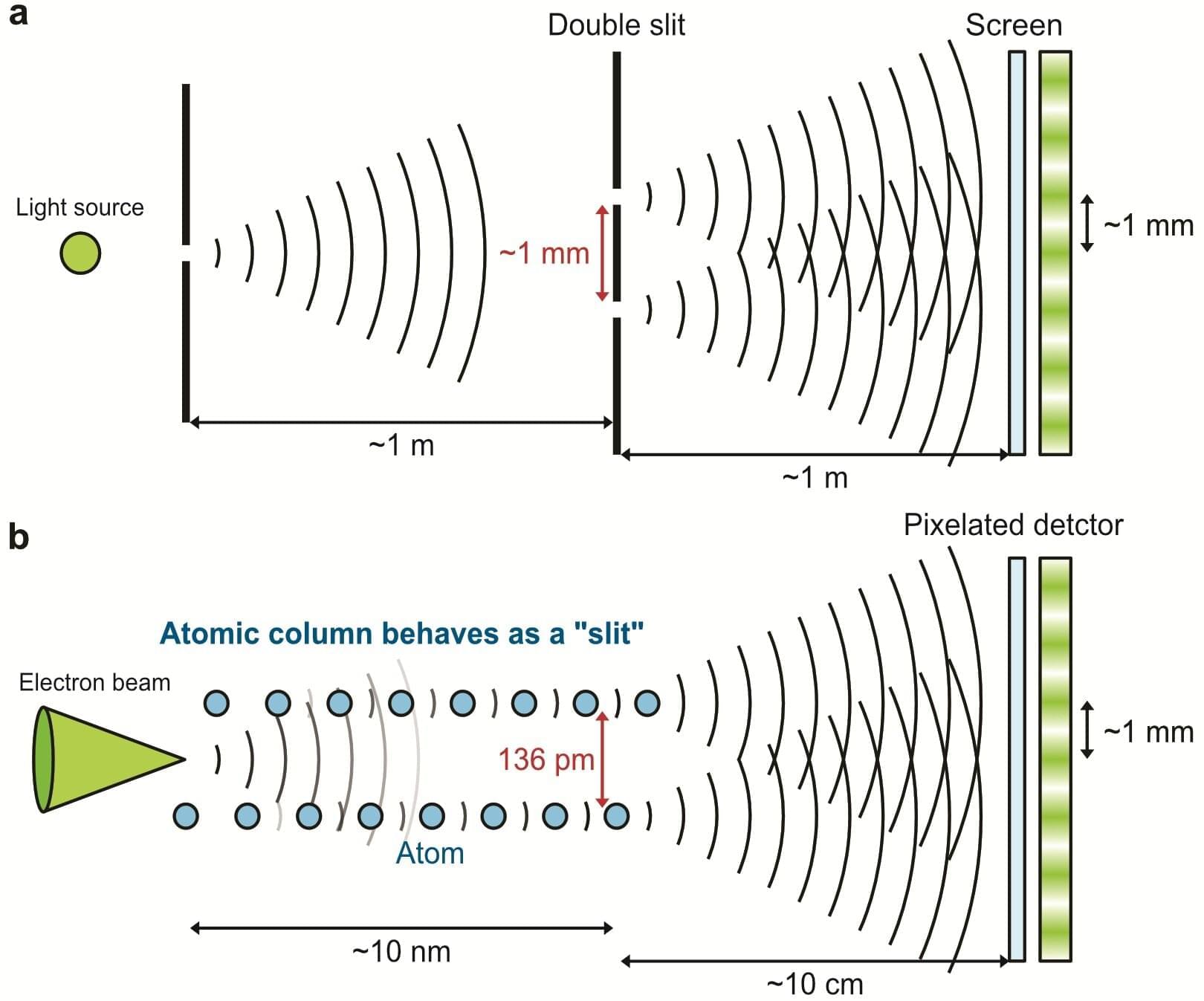
A research group made up of Director and Professor Naoya Shibata, JSPS Research Fellow Koudai Tabata, Associate Professor Taketo Seki and Project Associate Professor Ryo Ishikawa, all of the Institute of Engineering Innovation, School of Engineering, The University of Tokyo, has succeeded in an atomic-scale double-slit experiment that treats neighboring atoms as “two slits” and demonstrates that it is possible to read out the vibration of atoms from the fringe pattern formed by electrons. Their paper is published in the journal Nature.
The double-slit experiment makes use of a phenomenon in which waves passing through two narrow slits overlap and create a pattern of bright and dark fringes. Since the British physicist Thomas Young first performed it using light in the early 19th century, it (Young’s experiment) has been known as a fundamental experiment demonstrating the wave nature of light. If this experiment could be reduced to the atomic scale inside a material, it would allow direct investigation of the arrangement and motion of atoms at the level of a single atomic bond, but an atomic-scale double-slit experiment of this kind has never been realized.