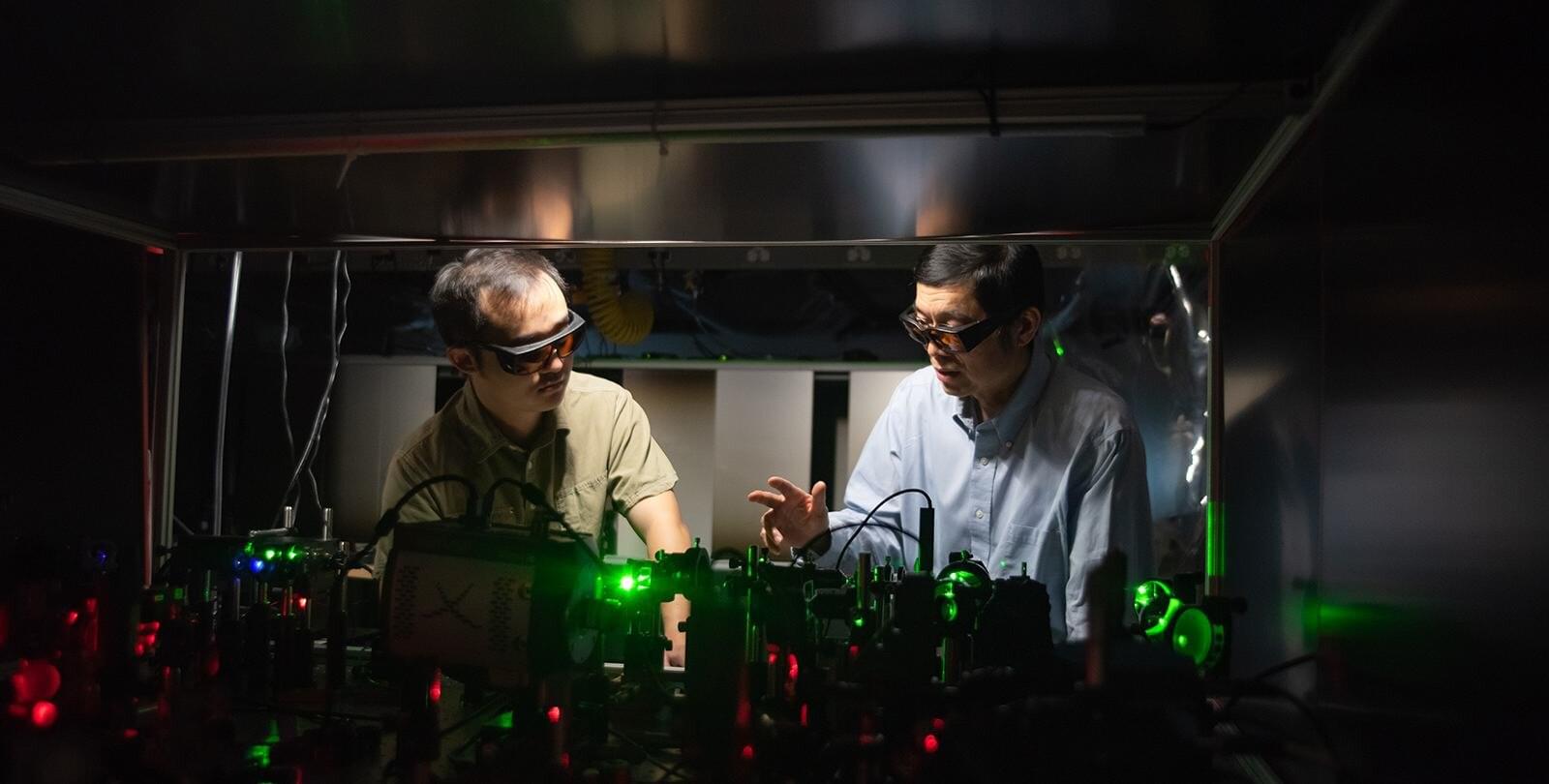
Three years after a team of Caltech scientists showed that pairs of entangled photons could double the resolution of a light microscope, the same lab has figured out a way to double down on that improvement. They have now achieved a fourfold resolution boost compared to a classical microscope, using a new optical design that sends one of the entangled photons through the microscope’s optics three times rather than just once.
The work, led by Lihong Wang, the Bren Professor of Medical Engineering and Electrical Engineering and the Andrew and Peggy Cherng Medical Engineering Leadership Chair at Caltech, builds on the lab’s 2023 demonstration of quantum microscopy by coincidence (QMC). The approach relies on one of those bizarre quantum-mechanical phenomena called entanglement, in which two particles are linked such that the state of one particle is intimately tied to the state of the other no matter how far apart they might be.
In QMC, entangled pairs of photons, called biphotons, are split so that one photon, called the signal photon, passes through the sample while its entangled partner, called the idler photon, travels a separate parallel path. In some ways, the pair behaves as a single particle that has twice the momentum of an individual photon.