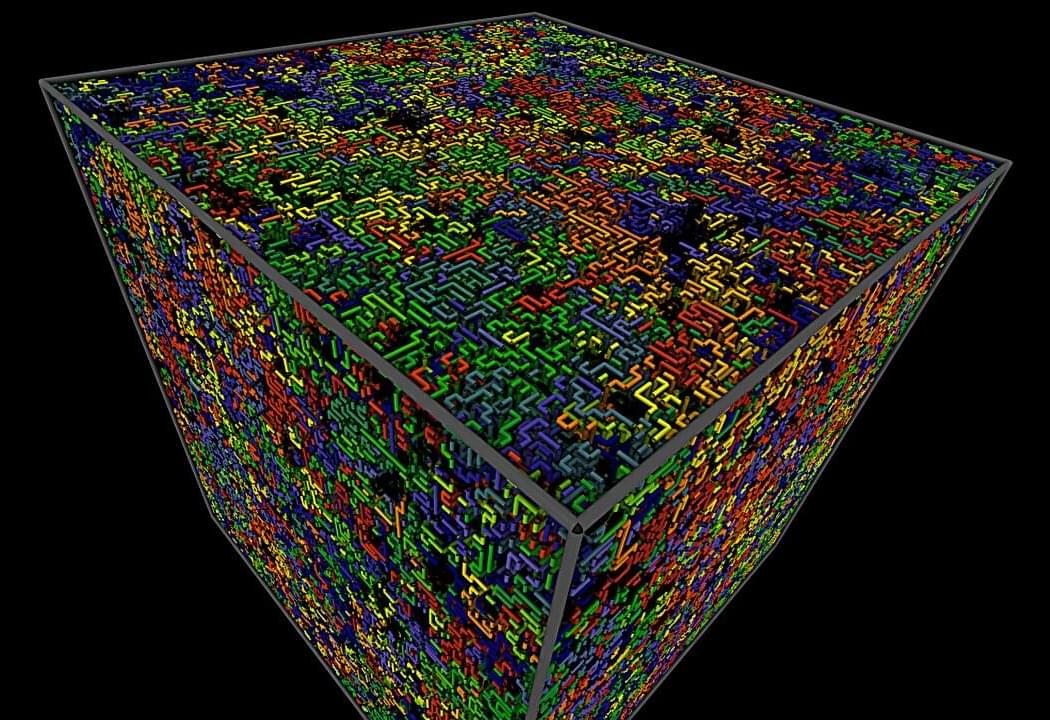
Long polymer chains are everywhere: in synthetic materials, soft matter, biological systems such as chromosomes, and mathematical models of filaments and knots. When many such chains are densely packed, they form what physicists call a polymer melt. In this crowded environment, each chain is constrained by the others around it. These entanglements are central to the behavior of polymeric materials, but they also make the systems extremely difficult to simulate. As chain length increases, the time needed to obtain a new independent configuration grows very rapidly. For very large systems, conventional simulations can therefore become computationally prohibitive.
For more than 70 years, scientists have used many “tricks” to speed up this process, including so-called Monte Carlo methods with ingenious moves designed to accelerate the evolution of the system. These methods helped, but the basic problem remained: In a dense melt, changes still had to propagate through a highly tangled system, slowing down the simulation.