While Earth’s core consists mostly of iron, its density implies that lighter elements are also mixed in. Because hydrogen is abundant in the universe and can mix with iron under certain conditions, scientists suspect it makes up part of the lighter-element composition. Data from earthquakes suggest the inner part of the core also changes with depth, but scientists aren’t sure exactly how this occurs. Now, a new study published in the Proceedings of the National Academy of Sciences indicates that hydrogen likely exists in a gradient within the inner and outer core that arises from thermodynamic equilibrium.
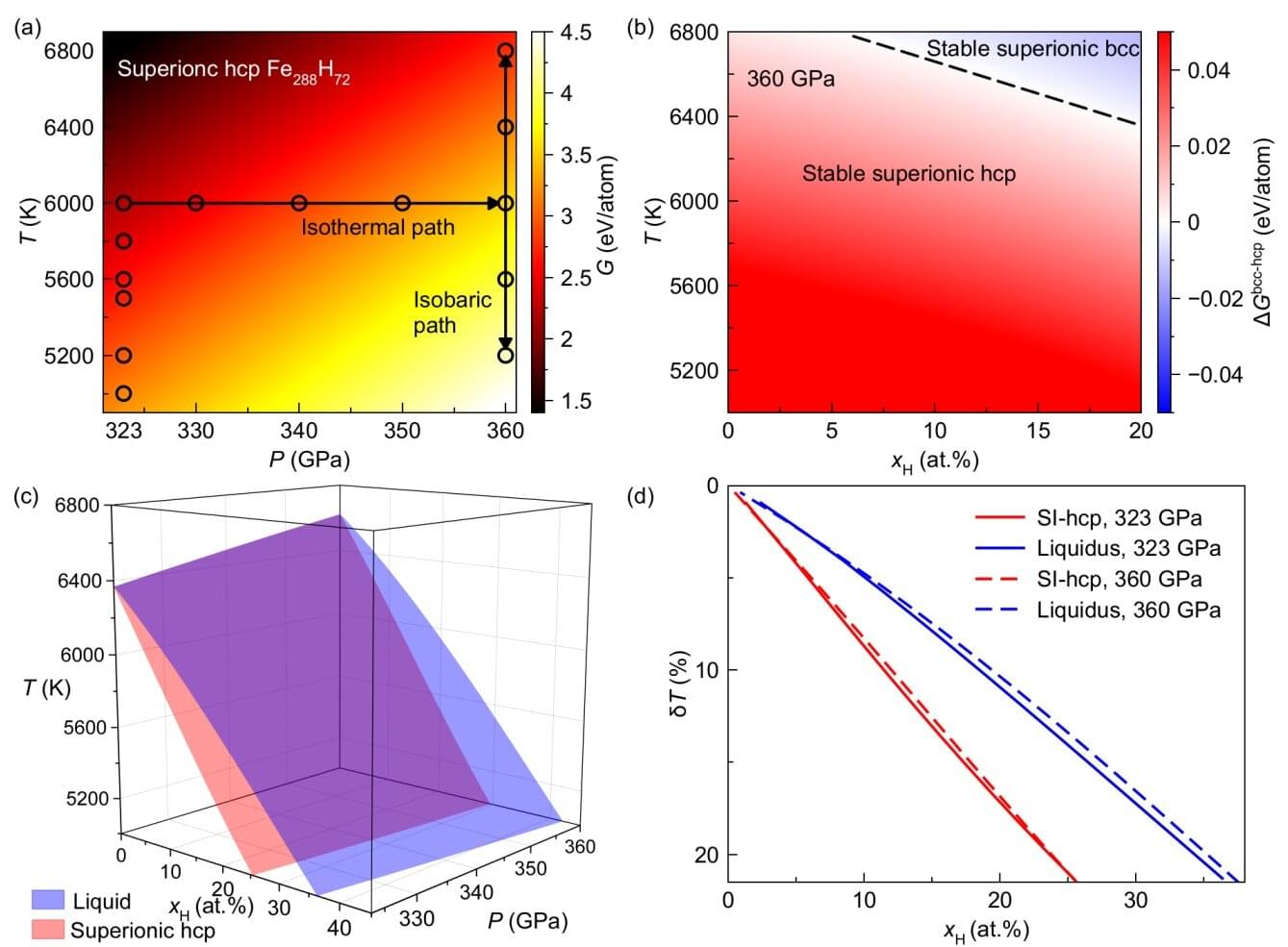
Hydrogen can dissolve into iron under extreme conditions, like the high-temperature, high-pressure conditions in Earth’s core. In the inner core, hydrogen may become superionic, allowing it to move through a solid iron crystal structure almost like a liquid. This superionic state does not behave like a conventional solid and can affect the thermodynamic properties of different phases. It’s thought that the inner core has a hexagonal close-packed (hcp) crystal structure, but other elements can take on a body-centered cubic (bcc) phase under similar conditions.
While it’s believed that hydrogen exists in a superionic state in an hcp lattice, it’s not clear whether hydrogen can also exist as a superionic species in a bcc lattice. The study authors say it’s also unclear how hydrogen might influence the competition between hcp and bcc phases in the inner core. It’s also not clear how or whether hydrogen abundance changes between the liquid outer core and the solid inner core. Previous modeling attempts have yielded conflicting results.