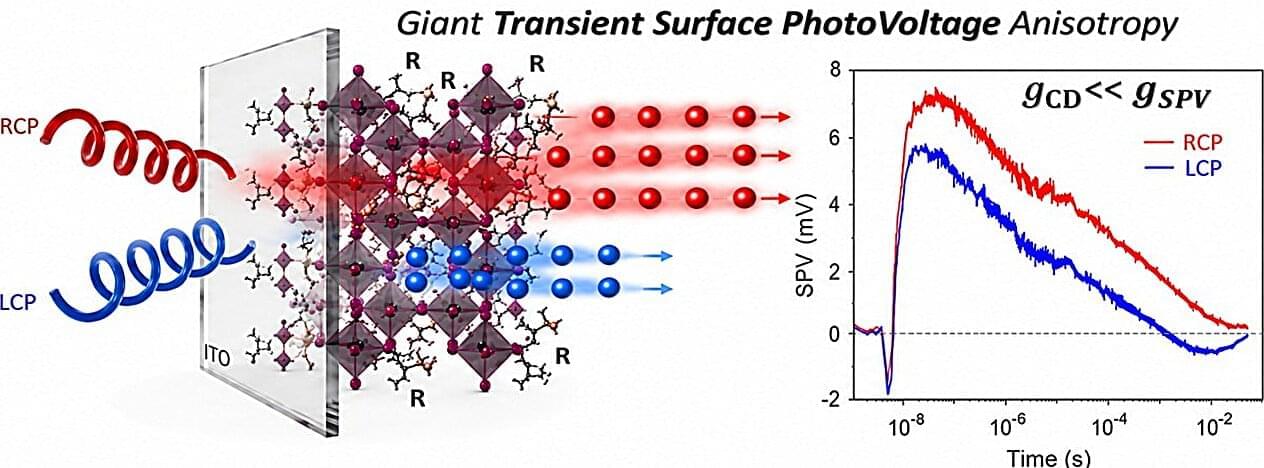
New research introduces a contactless way to see how mirror-image materials respond differently to circularly polarized light, without first building them into a complete electronic device. The researchers developed a novel method based on light-induced charge separation that allows researchers to directly probe how the material’s structure acts like a microscopic filter, influencing how electrons separate and move.
The advance is important because it gives scientists a faster, cleaner way to test promising materials without metal contacts and other parts of a finished device affecting the results. The approach could ultimately help researchers develop new mirror-image materials for technologies that use circularly polarized light, electrical charge and electron spin.
Imagine two nearly identical materials sitting side by side. They are mirror images of each other, much like your left and right hands. Shine an ordinary light on them, and they seem much the same. But shine light that twists in one direction, and one material responds more strongly. Twist the light the other way, and its mirror-image partner takes the lead.