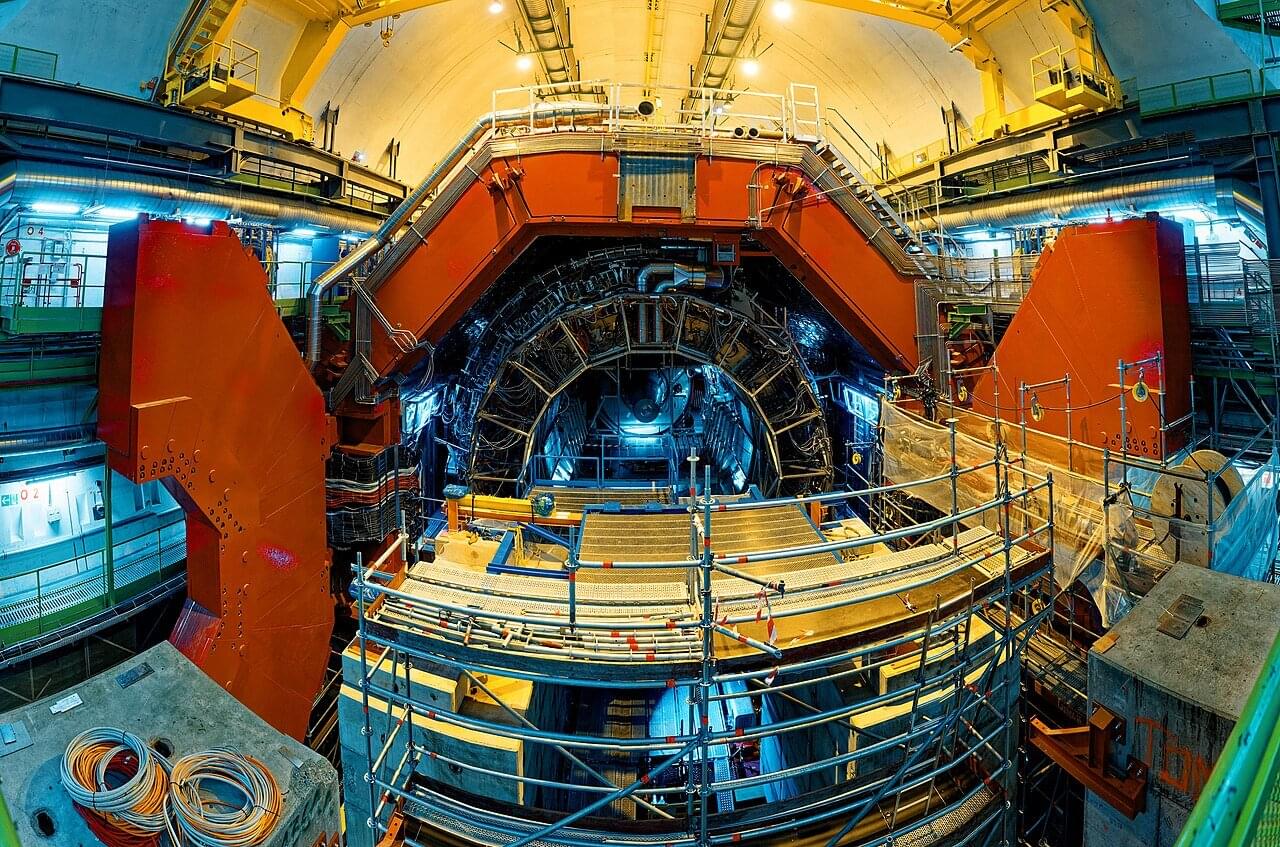
A University of Kansas physicist played a leading role in a CERN study showing that two rival explanations for how gluons behave inside atomic nuclei can now be experimentally distinguished.
The research, carried out within the ALICE experiment at CERN’s Large Hadron Collider and published in Physical Review Letters, reports the first multidimensional measurement of incoherent J/ψ (pronounced “JAY-sigh”) photonuclear production as a function of both interaction energy and momentum transfer. The measurement gives scientists their clearest view yet of how gluons, the particles that bind quarks together, are arranged inside atomic nuclei at high energies.
“Although quarks are often described as the fundamental building blocks of matter, nearly all the mass of the visible universe—from the atoms in our bodies to the matter inside stars—actually comes from the energy carried by gluons and the strong force that binds quarks together,” said nuclear physicist Daniel Tapia Takaki, professor of physics & astronomy at KU and member of the ALICE collaboration. “Understanding how gluons behave inside nuclei is therefore essential to understanding how matter itself acquires its mass and structure.”