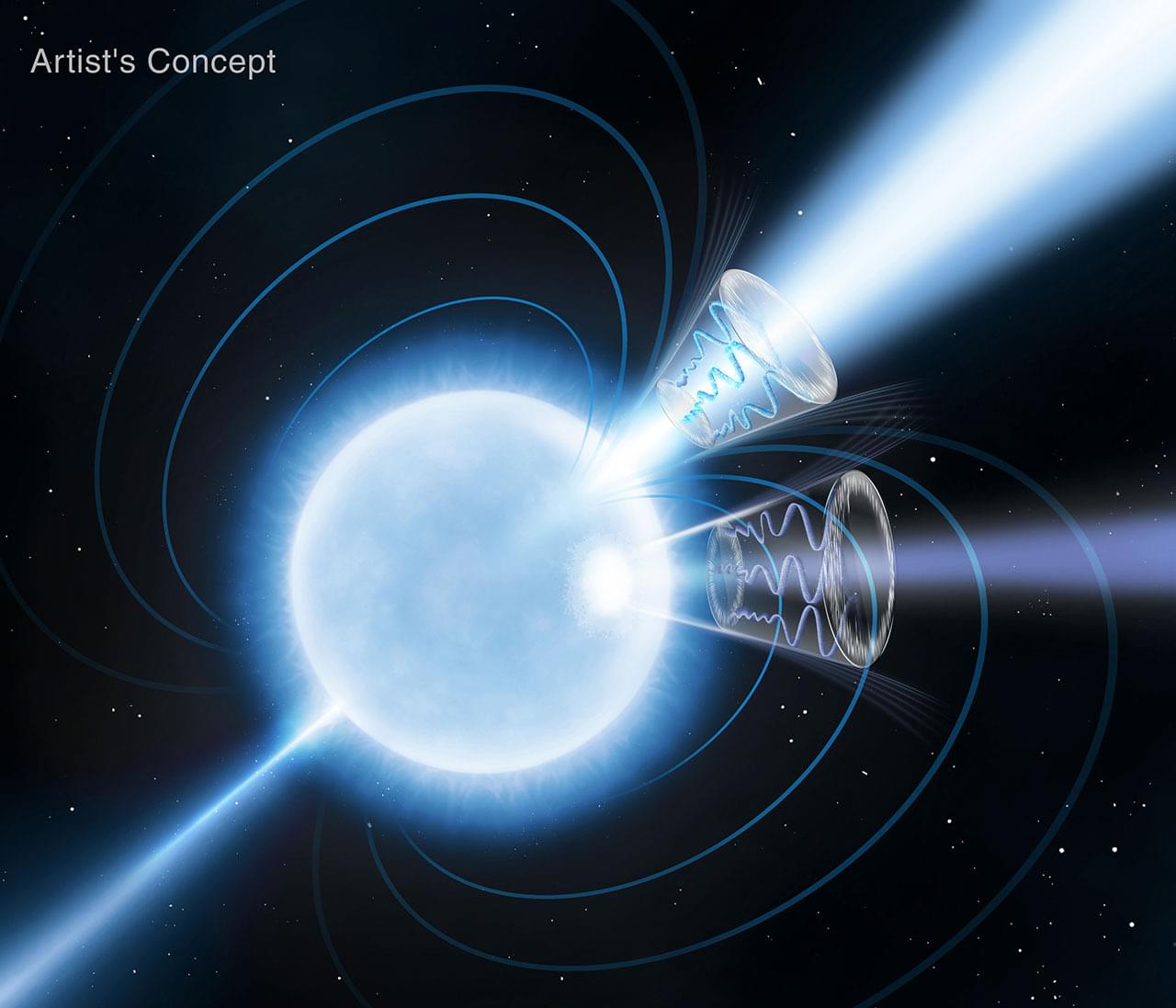
Scientists using NASA’s IXPE (Imaging X-ray Polarimetry Explorer) conducted more than 140 hours of observations of the magnetar 1E 1547–5408 between March and April 2025 alongside NASA’s NICER (Neutron Star Interior Composition Explorer) and Murriyang, CSIRO’s Parkes radio telescope, owned and operated by Australia’s national science agency. This was the first-ever coordinated radio and X-ray polarization measurement of a magnetar.
1E 1547–5408, spinning in a full rotation every 2 seconds, is a unique magnetar that consistently emits bright radio energy and X-ray light, for reasons scientists are still trying to understand.
Observations showed the polarization, or the orientation and level of alignment of the incoming photons, is nearly three times greater than seen in similar sources. This high level of polarization was surprising, since the geometry of the magnetar’s magnetic fields suggest that the measurements we see should be close to zero at certain points in the star. Standard surface emission models do not explain this large value either, indicating that another effect must be boosting the polarization.