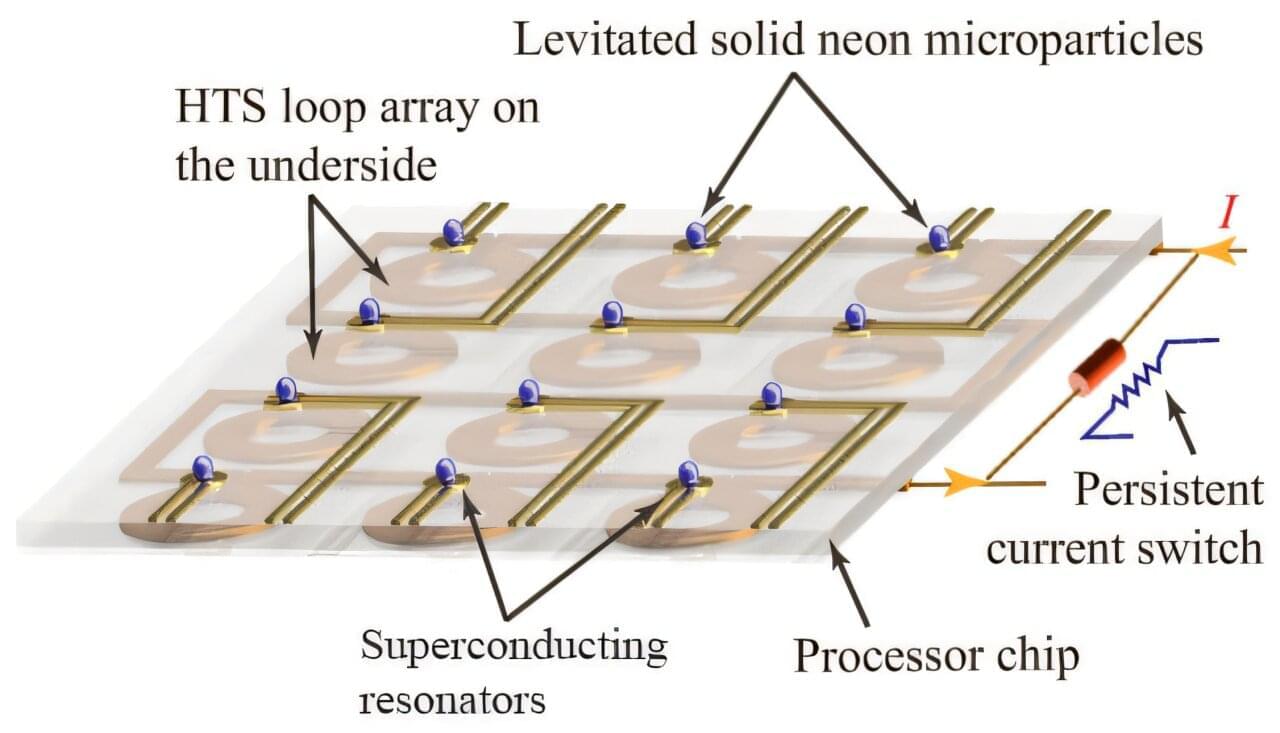
Researchers at the FAMU-FSU College of Engineering and the National High Magnetic Field Laboratory, headquartered at Florida State University, have designed a new quantum computing architecture that uses magnetic levitation to smooth over design flaws in the intricate components necessary to run a quantum computer.
Quantum bits, or qubits, can be as small as a few nanometers, and manufacturing them inevitably introduces random flaws on their surfaces. By using superconducting magnets to levitate neon particles, the research addresses a challenge in electron-on-neon qubit devices: the tendency for electrons to become trapped by tiny random bumps on the neon surface, making them function unpredictably.
The study, published in PRX Quantum, could help pave the way for more reproducible and scalable quantum computing technologies.