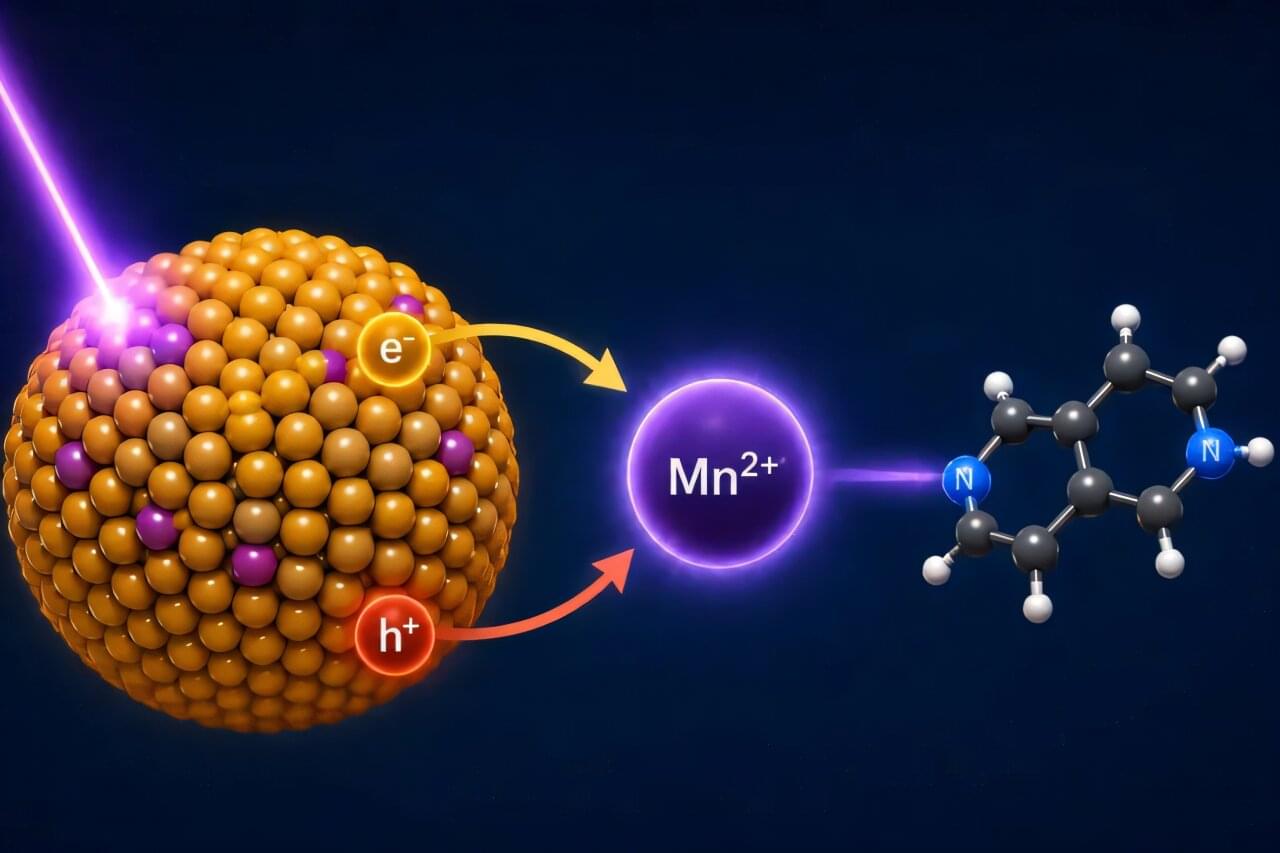
Scientists at Los Alamos National Laboratory have demonstrated a new quantum-dot mechanism that could significantly expand the reach of light-driven chemistry. By introducing magnetic manganese dopants into semiconductor quantum dots, the team created an ultrafast spin-exchange pathway that captures hot-electron energy before it is lost as heat and uses it to drive chemical reduction.
The work, published in Nature Communications, provides a direct demonstration that magnetic dopants can enable efficient hot-electron reduction in quantum dots. Using methyl viologen as a model molecular acceptor, the researchers showed that manganese-doped quantum dots can transfer electrons significantly faster than undoped particles and can drive reduction even when conventional band-edge energetics are unfavorable.
“Our study shows that magnetic dopants can do much more than modify the optical properties of quantum dots,” says Victor Klimov, laboratory fellow at Los Alamos and principal investigator on the project. “They can capture hot-exciton energy on ultrafast time scales and redirect it into useful chemistry, which opens a fundamentally new route to high-energy photoreduction.”