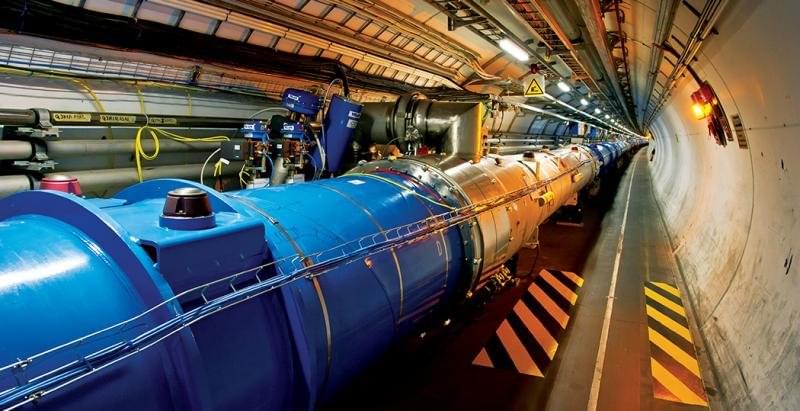
Many people are aware that the Large Hadron Collider (LHC) at CERN smashes tiny subatomic particles together at nearly the speed of light to test foundational laws of physics and discover new fundamental particles, but some experiments also help scientists better visualize the actual structure of atoms we are already familiar with, like oxygen and neon.
While science textbooks often feature pictures of these and other atoms as if their nuclei are well-defined structures, the reality is more complicated. A new study, published in Physical Review Letters, reveals new details about the internal structure of oxygen and neon from the flow of particles coming out of oxygen-oxygen and neon-neon collisions in the LHC.