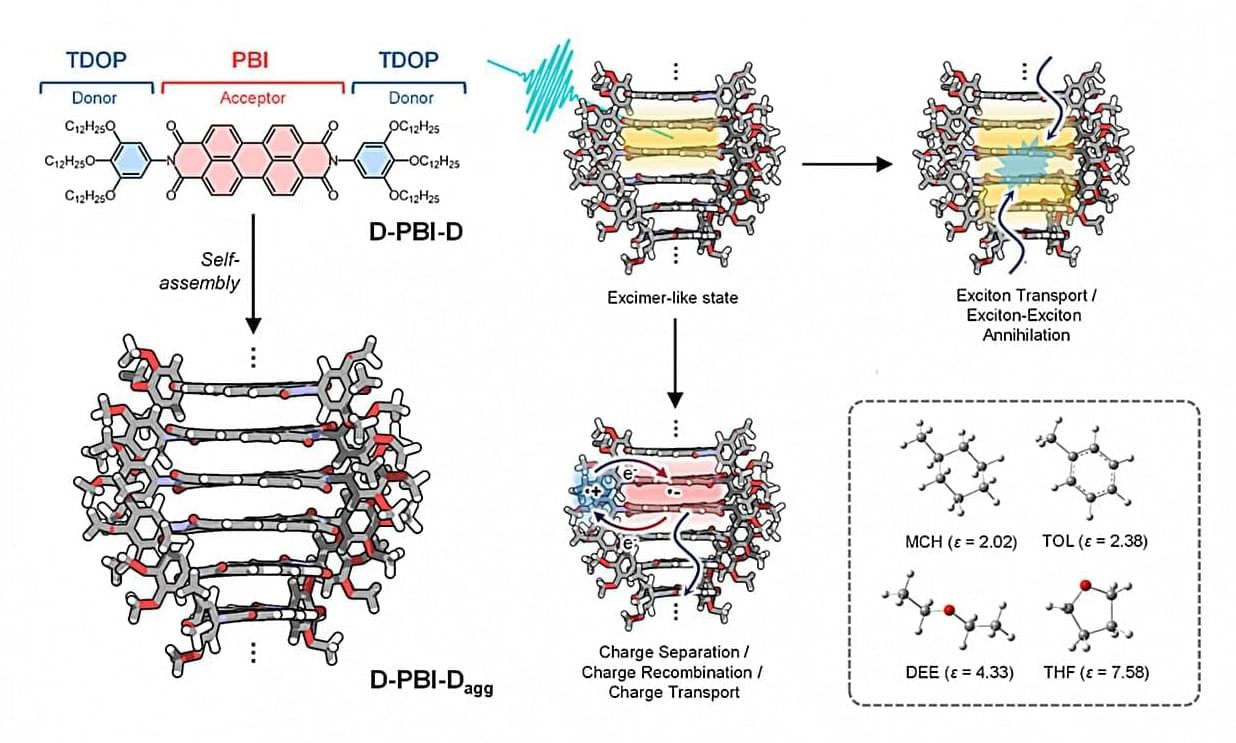
A research team led by Taeyeon Kim, a professor in the Department of Chemistry at Sungkyunkwan University, in collaboration with a team from Yonsei University, has identified a new principle that controls charge separation, a phenomenon that plays a central role in both plants’ generation of electrical energy (photosynthesis) and next-generation molecular semiconductor devices.
The findings were published in Nature Communications.
When plants absorb sunlight to generate energy, they rapidly separate and transfer charge within their internal structures. Inspired by this process, the scientific community has long sought to develop next-generation energy devices such as artificial photosynthesis systems and organic solar cells. Molecular aggregate structures formed by densely stacked “perylene bisimide (PBI),” an organic semiconductor molecule known for its excellent electron-accepting properties, have drawn particular research attention. However, the complex environment created by tightly clustered molecules has made it difficult to precisely determine how the surrounding environment alone affects charge transfer.