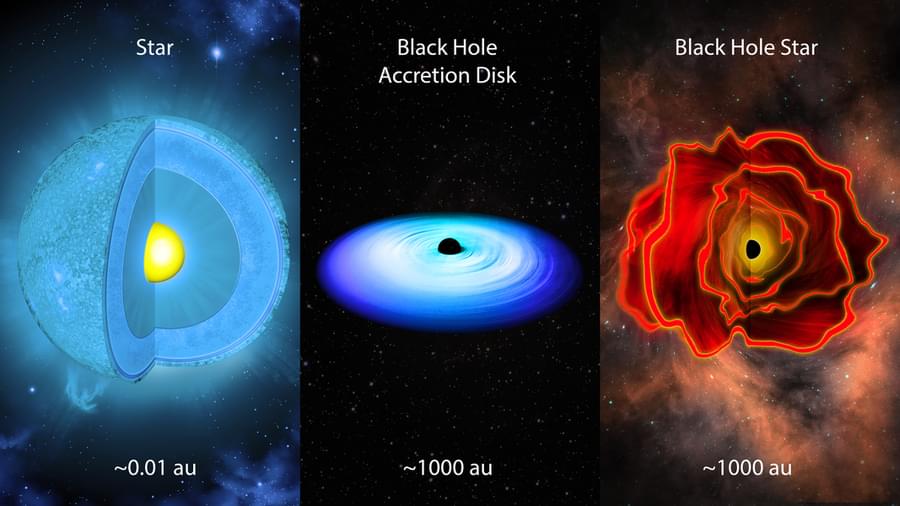
Astronomers may have uncovered an entirely new cosmic object: a gigantic “black hole star” that could explain the mysterious red dots filling the early universe. Astronomers from MIT and other institutions have identified an exceptionally bright red object dating back to the early universe. At first glance, it resembles an enormous star with dimensions comparable to our solar system. Its energy output, however, is extraordinary. The object is producing roughly 100 billion times more energy than any known star could physically generate, putting its power much closer to the levels associated with black holes.
That unusual combination has led researchers to propose that the red object represents an entirely new kind of astrophysical source. They are calling it a “black hole star.”
A study published on August 12 in Nature describes the object and the team’s analysis of observations made with NASA’s James Webb Space Telescope (JWST). The telescope detected the bright red dot in the very early universe, only a few hundred million years after the Big Bang.