Consider a primary care physician seeing a patient aged 58 years for routine follow-up. The electronic health record (EHR) alerts that the patient is eligible for statin therapy. The physician overrides it, as clinicians do for the vast majority of alerts. The system verifies what is computationally easy (eg, age, lipid values, and risk score) but ignores what the clinician needs: has this patient been offered statins before? Did they decline, and if so, why (cost concerns, fear of adverse effects, preference for lifestyle modification)? Have they tried statins previously and experienced muscle pain? If they were prescribed a statin, did they ever pick it up from the pharmacy? What did they write in that patient portal message 2 months ago when they mentioned reading online that statins cause memory problems? The answers are scattered across notes, dispensing records, and portal messages. The alert identifies eligibility but not the patient’s decision state or the barriers to action.
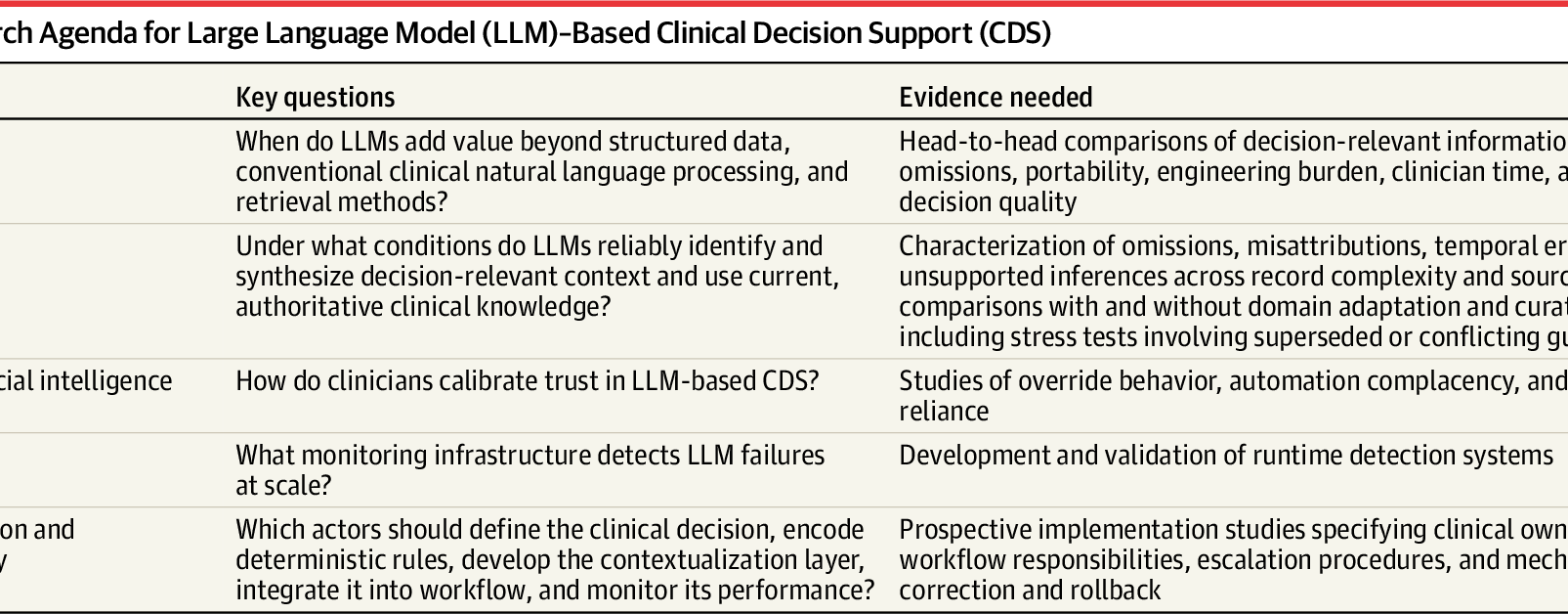
Consistent with established definitions, clinical decision support (CDS) includes tools that provide knowledge and patient-specific information to support health decisions and is not limited to guideline adherence.1,2 This Perspective focuses on clinician-facing CDS organized around a defined decision; generic note drafting, inbox management, and open-ended chart summarization are excluded unless they directly support that decision. A prior reason for declining statin therapy is relevant because it changes the next action, not eligibility. Deterministic methods remain preferable when criteria and outputs are explicit; large language models (LLMs) may extend them through flexible synthesis and adaptive presentation.
Early medical LLM applications have focused on drafting replies and summarizing charts.3,4 The larger opportunity is to revisit a long-standing trade-off between clinical fidelity and computational tractability. Health information technology has historically represented complex narratives and knowledge through structured fields and rules because they were computable.5 LLMs do not provide the first access to narrative text; their incremental value is the flexibility to extract, synthesize, and communicate across heterogeneous sources.