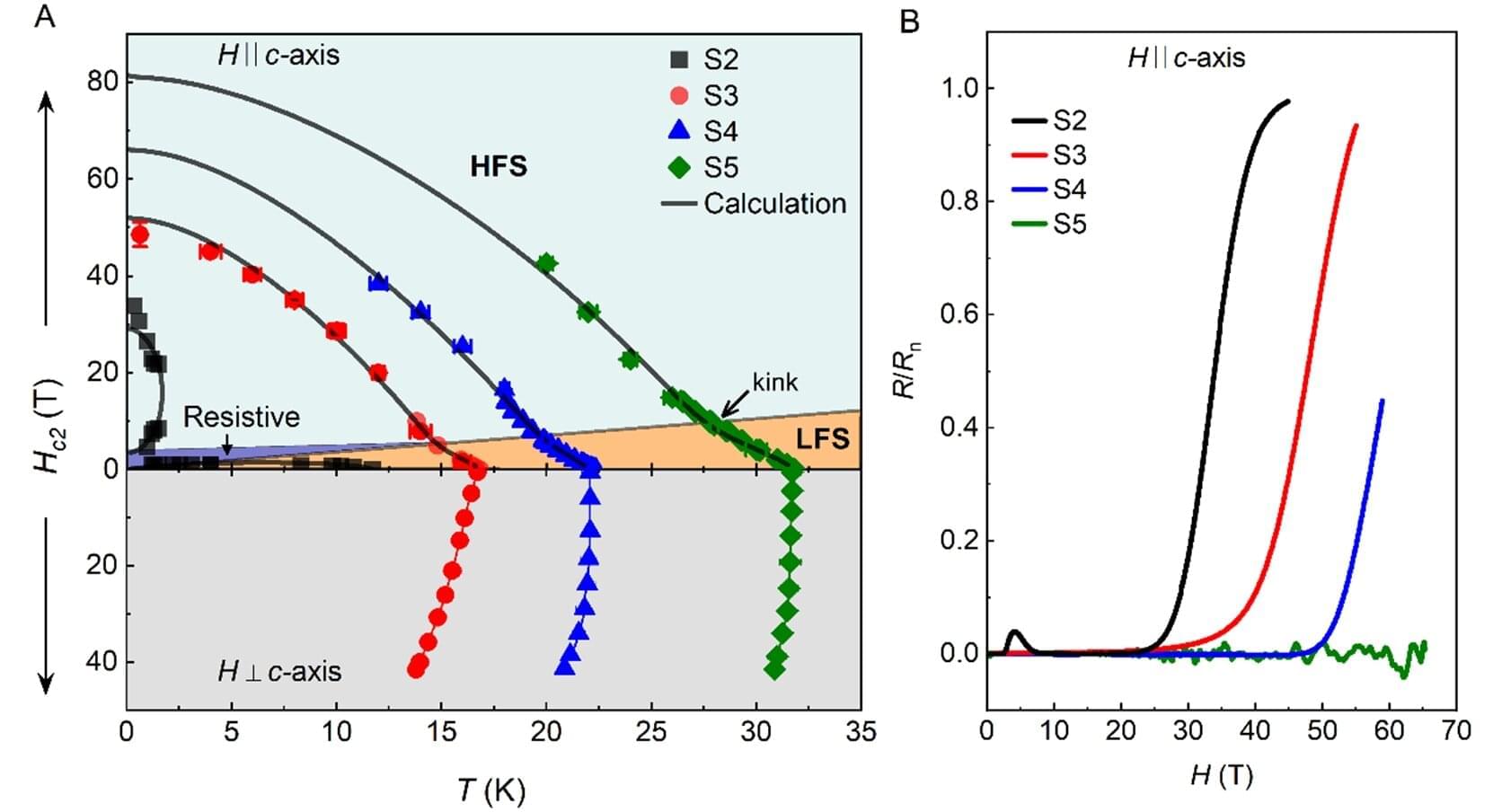
Scientists from the National University of Singapore (NUS), in collaboration with Los Alamos National Laboratory in the United States, have uncovered that a class of nickel-based materials known as samarium (Sm)-based infinite-layer nickelates can regain their superconducting ability under strong magnetic fields. This behavior could open a promising pathway toward superconducting technologies that can operate under extreme magnetic conditions.
Superconductivity, the ability of certain materials to conduct electricity without resistance, is typically destroyed by strong magnetic fields. However, a research team led by Professor Ariando from the Department of Physics at NUS, working with scientists from Los Alamos National Laboratory, has shown that Sm-based infinite-layer nickelates defy this expectation.
In these nickelates, superconductivity is first suppressed at low magnetic fields of a few tesla, only to reappear as the field increases, persisting beyond 60 tesla (hundreds of thousands of times stronger than Earth’s magnetic field). This unusual behavior, known as reentrant superconductivity, has previously been observed only in materials with very low transition temperatures, limiting their practical relevance.