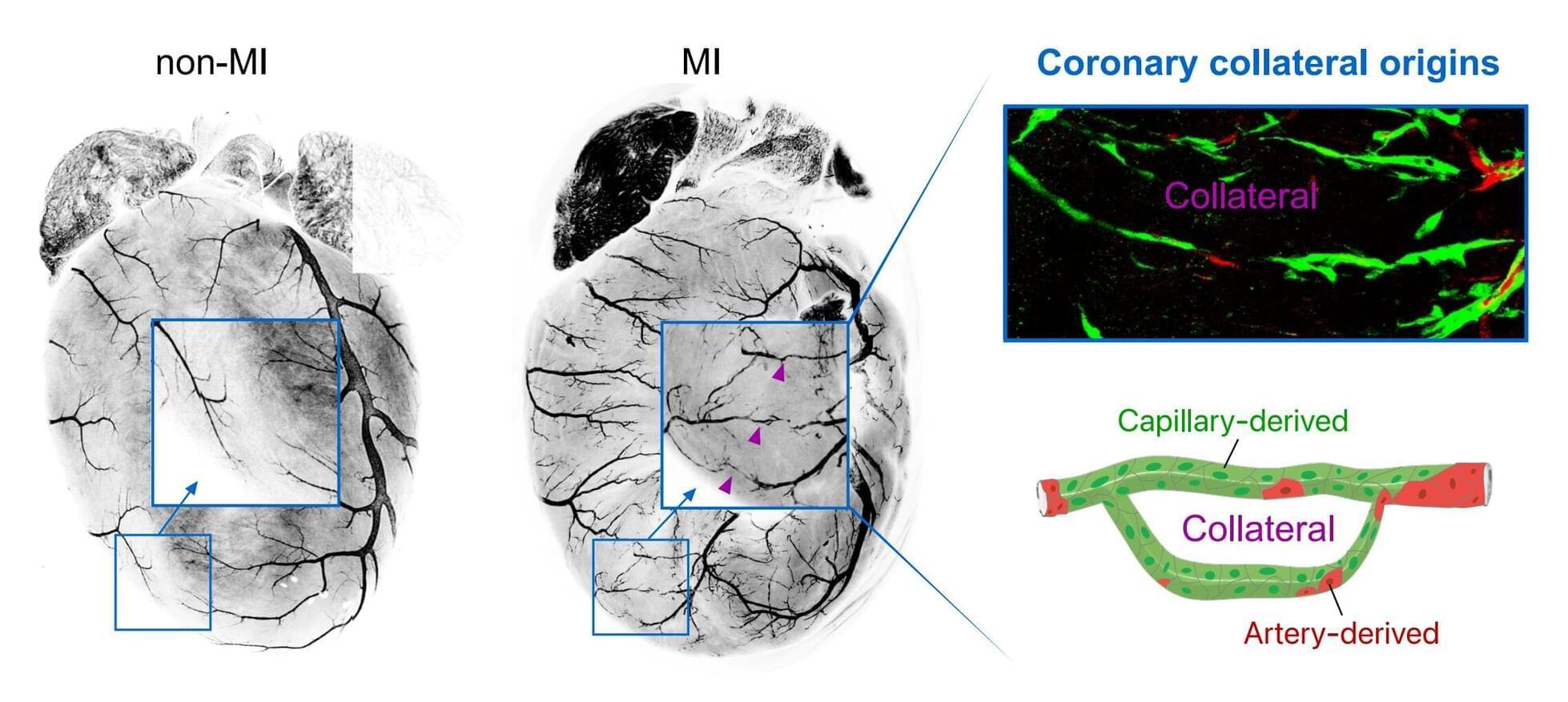
The heart powers a busy highway of arteries and vessels, providing a constant to-and-fro passage for blood. During a heart attack, this passage becomes blocked, usually when a blood clot forms on plaque in a coronary artery and cuts off blood flow to the heart muscle. A study published in Science found that the heart tries to save itself by growing new natural bypass channels to bring blood and oxygen back to damaged tissue.
For a long time, the prevailing theory was that new backup vessels, also known as coronary collateral arteries, grew when cells from existing arteries broke away and assembled into new arteries. The researchers designed genetic tools with fluorescent markers that glow in different colors depending on whether they contact the smooth muscle cells (SMCs) of mature arteries or the bare surface of capillaries, the tiniest blood vessels.
When injected into mice, the tools revealed that capillaries, rather than existing arteries, did most of the heavy lifting in forming new coronary collateral arteries after a heart attack. Capillaries changed their identity and grew into larger, fully mature arteries through a process called capillary arterialization.