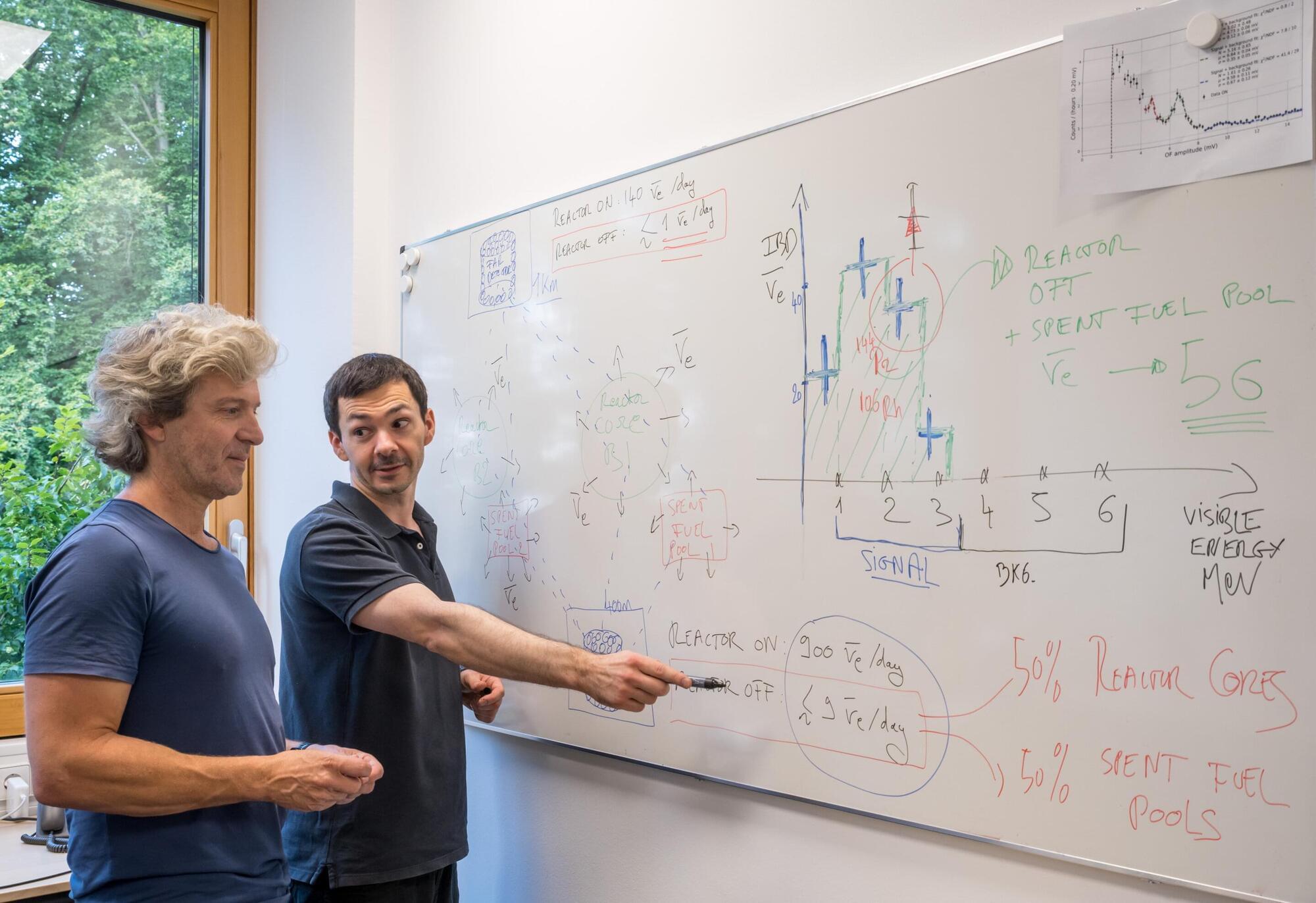
Even when the lights go out and nuclear reactors are turned off, the story inside the reactor core still has a great deal to tell. Radioactive, long-lived fission products continue to decay for months or even years, producing a faint flux of a specific type of particle known as antineutrinos. (Anti)neutrinos are the lightest and most elusive known particles in the universe, allowing them to escape unhindered from both the reactor and the surrounding shielding.
Researchers in the Double Chooz collaboration have now measured this residual antineutrino emission for the first time. The study, which was published in Physical Review Letters, was led by Anthony Onillon and Thierry Lasserre from the Max-Planck-Institut für Kernphysik (MPIK) in Heidelberg, Germany.
The results demonstrate that antineutrino detectors can probe nuclear reactors even during shutdown periods, opening new perspectives for reactor monitoring, nuclear safety and safeguards.