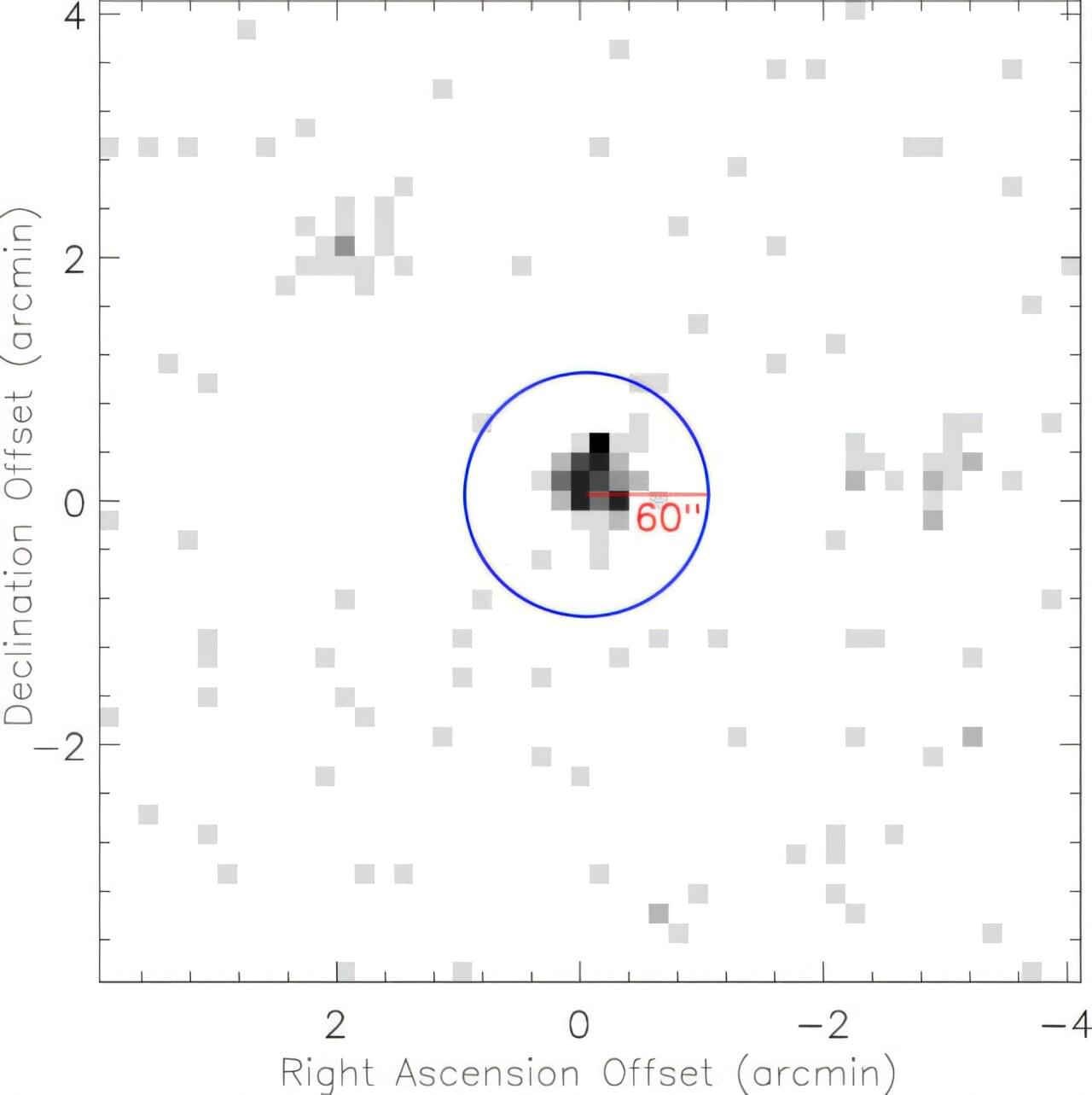
For more than two decades, the quasar PHL 1811 has been considered the prototype of a rare class of “intrinsically X-ray weak” quasars, thought to produce unusually little X-ray radiation. But in 2024, the Einstein Probe spacecraft caught the object in a bright X-ray flare. In a new study, astronomers combined that observation with more than 20 years of archival data to revisit the mystery. The findings were published in The Astrophysical Journal on July 28.
In active galactic nuclei (AGN), material spiraling into the central black hole releases enormous amounts of energy. The accretion disk—the swirling ring of hot gas around the black hole—releases this energy primarily in optical and ultraviolet (UV) light. Additionally, a separate region of extremely hot plasma, called the corona, sits above the disk and is responsible for the X-ray emission. The link between these two emissions is well established.
A rare subset of AGNs breaks this pattern, appearing far dimmer in X-rays than expected, often linked to black holes feeding faster than the theoretical limit. This could mean either that gas is blocking the X-rays without dimming the optical/UV, or that it is “intrinsically weak” as the X-ray-emitting corona itself is genuinely suppressed.