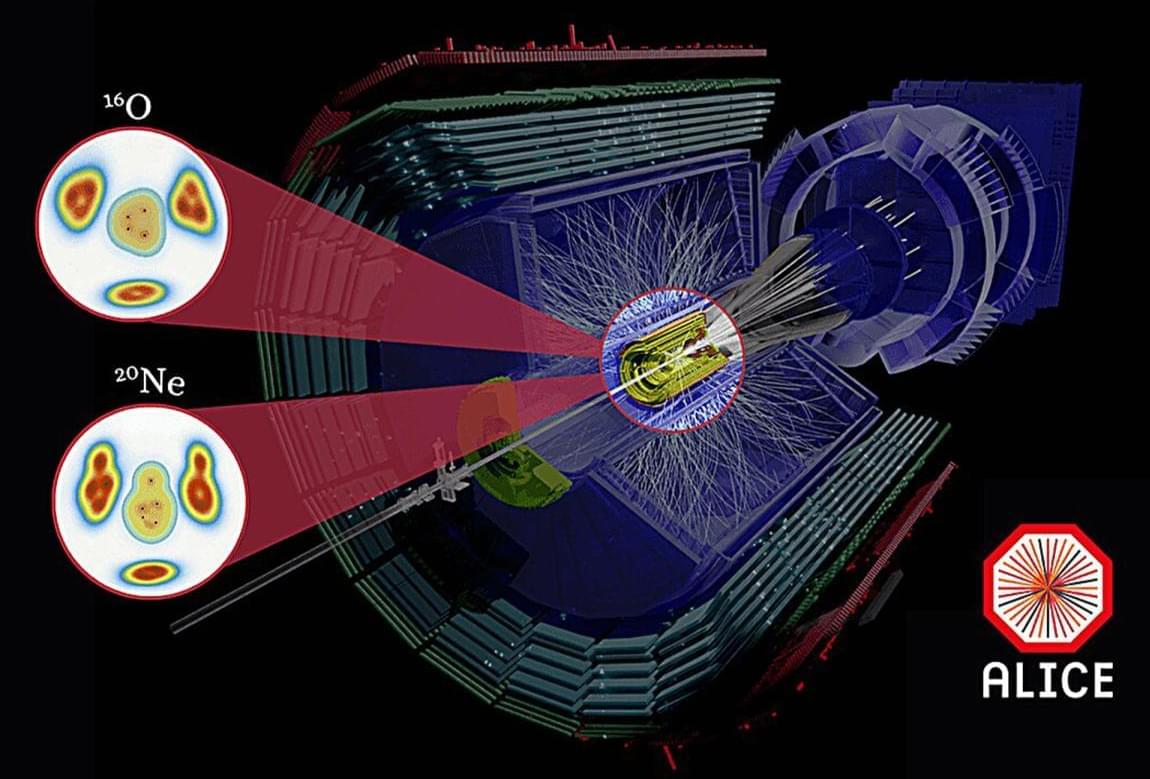
The experiment works by colliding the oxygen and neon nuclei to create a tiny blob of quark-gluon plasma — the same super-hot “soup” scientists think filled the universe right after the Big Bang.
The collision produces a droplet of that plasma that expands and cools in an instant, too fast for scientists to observe directly, so instead, scientists studied the particles it leaves behind, which turned out to reveal something unexpected, Zhou explained.
What they found, according to the study, is when two oxygen atoms smashed together, the particles sprayed out in a rounded pattern, but when two neon atoms collided, the particles actually came out shaped more like a bowling pin — which matches the true geometry of a neon nucleus, according to the study.