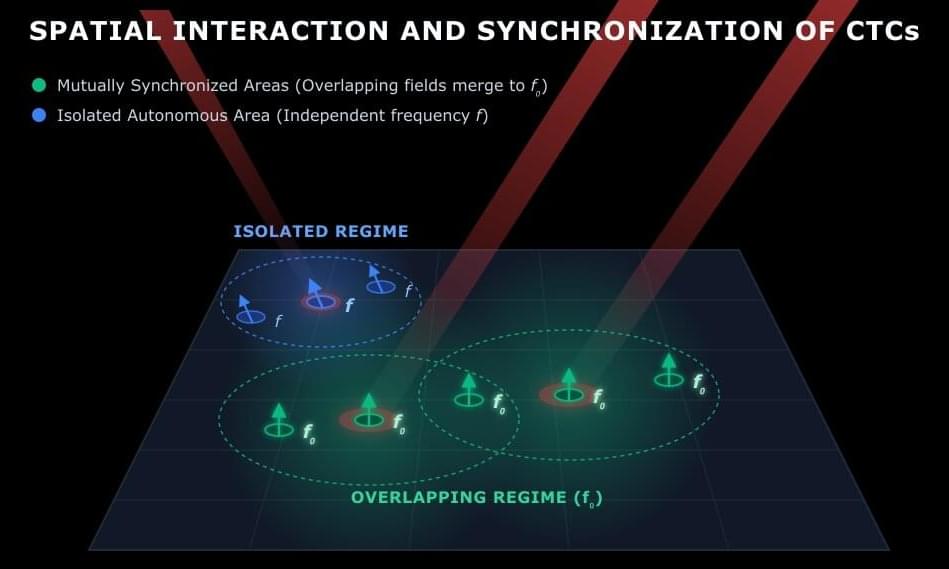
In January 2024, physicists at TU Dortmund University demonstrated a continuous time crystal in a semiconductor whose oscillations remained stable for hours. In a new study published in Nature Communications, Professor Alex Greilich and his team show that many such time crystals can form in the same material and synchronize their electron-nuclear spin oscillations.
Time crystals are systems whose internal dynamics repeat periodically in time without being driven by a periodic external signal. In the TU Dortmund experiment, they are created in a semiconductor made of gallium arsenide containing small amounts of indium and silicon, which provides localized electrons. At temperatures close to −270°C (−454°F), each electron interacts with about one million surrounding nuclear spins.
A pump laser aligns the electron spins, which transfer their polarization to the nuclear spins. In a weak magnetic field, the nuclear-spin polarization begins to rotate. The resulting feedback between the electron and nuclear spins sustains the oscillations, while a second laser is used to observe them.