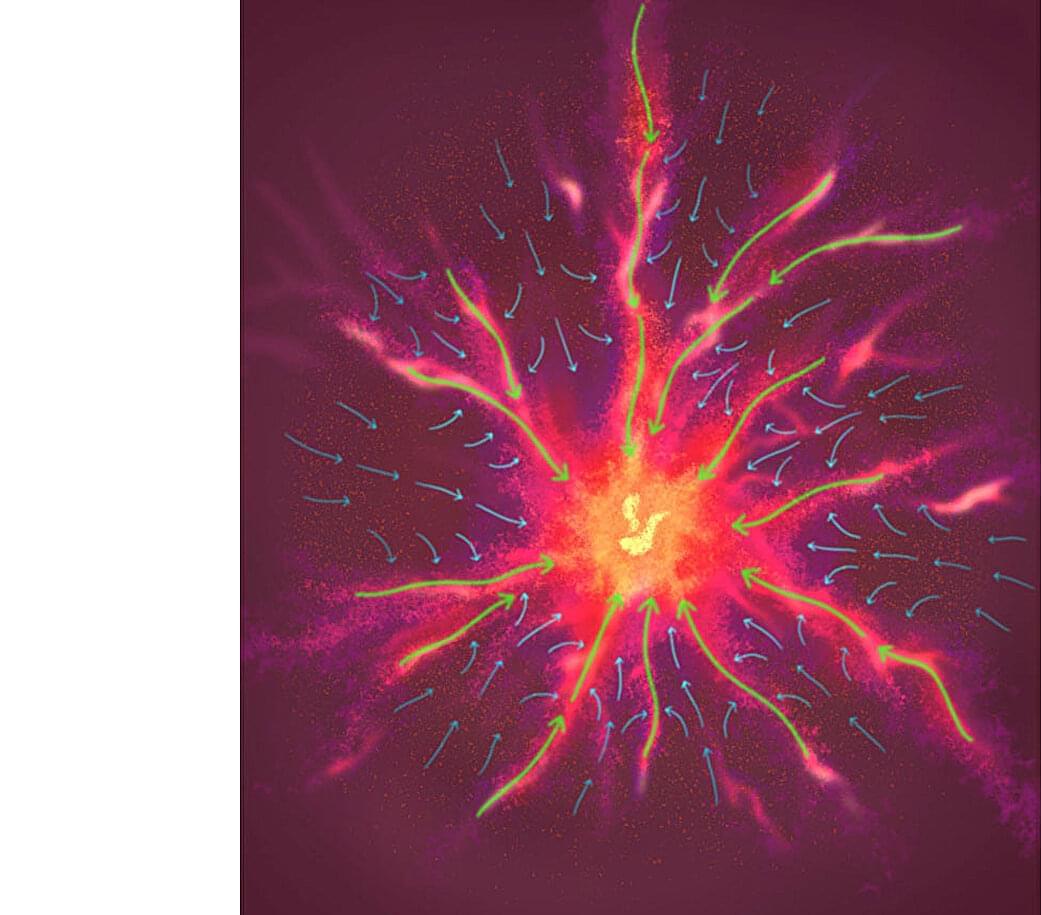
Researchers from Kyushu University have discovered that diffuse gas surrounding dense filaments in a nearby stellar nursery plays a much larger role in star formation than previously recognized. By tracking the movement of gas in the Monoceros R2 hub–filament system, the team found that low-density gas contributes to hub growth both through direct inflow and by replenishing nearby dense filaments. Their findings show that overlooking this diffuse gas could substantially underestimate the amount of material available to build massive stars.
Stars form inside interstellar clouds of gas and dust, but the process is far from well understood. Within these clouds, long, threadlike structures known as filaments often converge into dense central regions called hubs, where clusters of stars and the most massive stars are born. Previous studies have shown that dense gas travels along these filaments into the hub. However, much less is known about the lower-density gas that fills the spaces between the filaments, leaving an incomplete picture of how these stellar nurseries gather enough material to sustain star formation.
Tracing gas beyond the filaments In the present study, published in The Astrophysical Journal Letters on June 10, 2026, a team led by assistant professor Jihye Hwang of Kyushu University’s Institute for Advanced Study worked with associate professor Doris Arzoumanian to investigate gas motions in the Monoceros R2 hub–filament system. Using observations of the carbon monoxide isotopes 13CO and C18O from the Nobeyama 45-m radio telescope, operated by Nobeyama Radio Observatory, a branch of the National Astronomical Observatory of Japan, the researchers identified three dense filaments and three inter-filament regions and measured gas motions toward the hub and neighboring filaments.