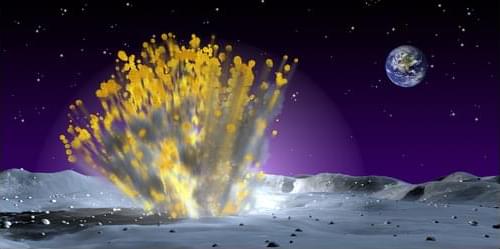
A model that captures how crater-forming impacts redistribute lunar dirt will help researchers read the cosmic timeline found in samples returned from the Moon.
The Moon’s soil preserves signatures of the solar wind, cosmic rays, and episodic stellar events, but frequent meteorite strikes scramble what would otherwise be a neatly layered record of cosmic history. Researchers have now developed a mathematical model that accounts for this scrambling effect in lunar soil [1]. The model can predict the depths and concentrations of radioactive isotopes originating from astrophysical events hundreds of light-years away. It provides a guide for future lunar sampling missions that will search for evidence of specific events in our Solar System’s history.
Samples returned from the Apollo missions suggest that irradiation and the solar wind alter the lunar surface soil’s chemistry and physical appearance as it ages. In addition, nearby supernovae emit radioactive isotopes, including short-lived ones such as iron-60. Meanwhile, meteorite impacts mix all this surface material and gradually transport it deep into the soil or upward from below in a process known as impact gardening. But models of this transport often fail to capture key features observed in the Apollo samples. For example, analysis of core samples (long, vertical cylinders of soil) suggest that, in some cases, the concentrations of certain isotopes have much steeper depth dependence than models predict.
It’s really not soil it’s regolith. Semantics aside, the Moon being a completely inert ball of rock makes it a great record of the solar system history