The transcription process is controlled by non-coding regulatory elements, more than 70% of which are putative enhancers. These enhancers comprise over 600,000 regions and are marked by histone modifications. However, the mechanisms by which altered enhancers in cancer cooperate within the three-dimensional chromatin architecture to drive oncogenic programs remain poorly understood.
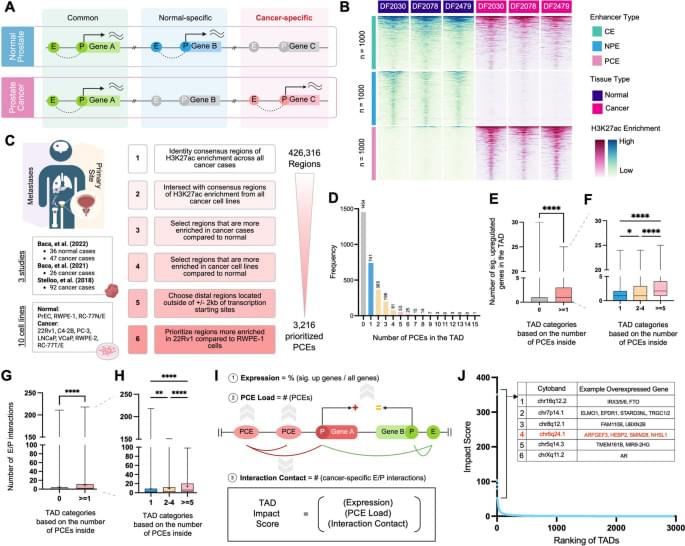
By integrating 201 H3K27ac ChIP-seq datasets from prostate, we identify 3,216 high-confidence prostate cancer-specific putative enhancers. Ultra-high-resolution chromatin interaction profiling by Region Capture Micro-C at a representative chr6q24.1 locus reveals that these enhancers form cancer-specific, highly nested interactions with promoters that coalesce into a multi-connected hub absent in normal prostate cells. CRISPR/Cas9 perturbations of these enhancers, examined one by one, distinguish enhancer classes within the hub. Deletion of a central enhancer collapses hub-wide enhancer activities and architecture, leading to the downregulation of target genes, impaired proliferation, and reduced clonogenic growth. In contrast, deletion of a redundant enhancer results in minimal transcriptional changes, as neighboring enhancers rescue cancer signaling through compensatory architectural rewiring that strengthens alternative enhancer-promoter interactions.