In Goethe’s ballad “Erlkönig,” immortalized in Schubert’s fevered 1815 setting, a dying boy riding through the night sees a spectral king beckoning from the darkness. His father calms him: “Mein Sohn, es ist ein Nebelstreif”—my son, it is only a wisp of fog. In the poem, the father’s reassurance proves tragically wrong. In the quantum world, however, his words acquire an uncanny new meaning.
For four decades, physicists have been haunted by their own apparition: a particle that scatters off a magnetic monopole and seems to vanish from the theory entirely, its outgoing state missing from the books. A team of physicists from Ghent University, the University of Cambridge and the University of Oxford now shows, in a paper published in Nature Physics, where such particles go.
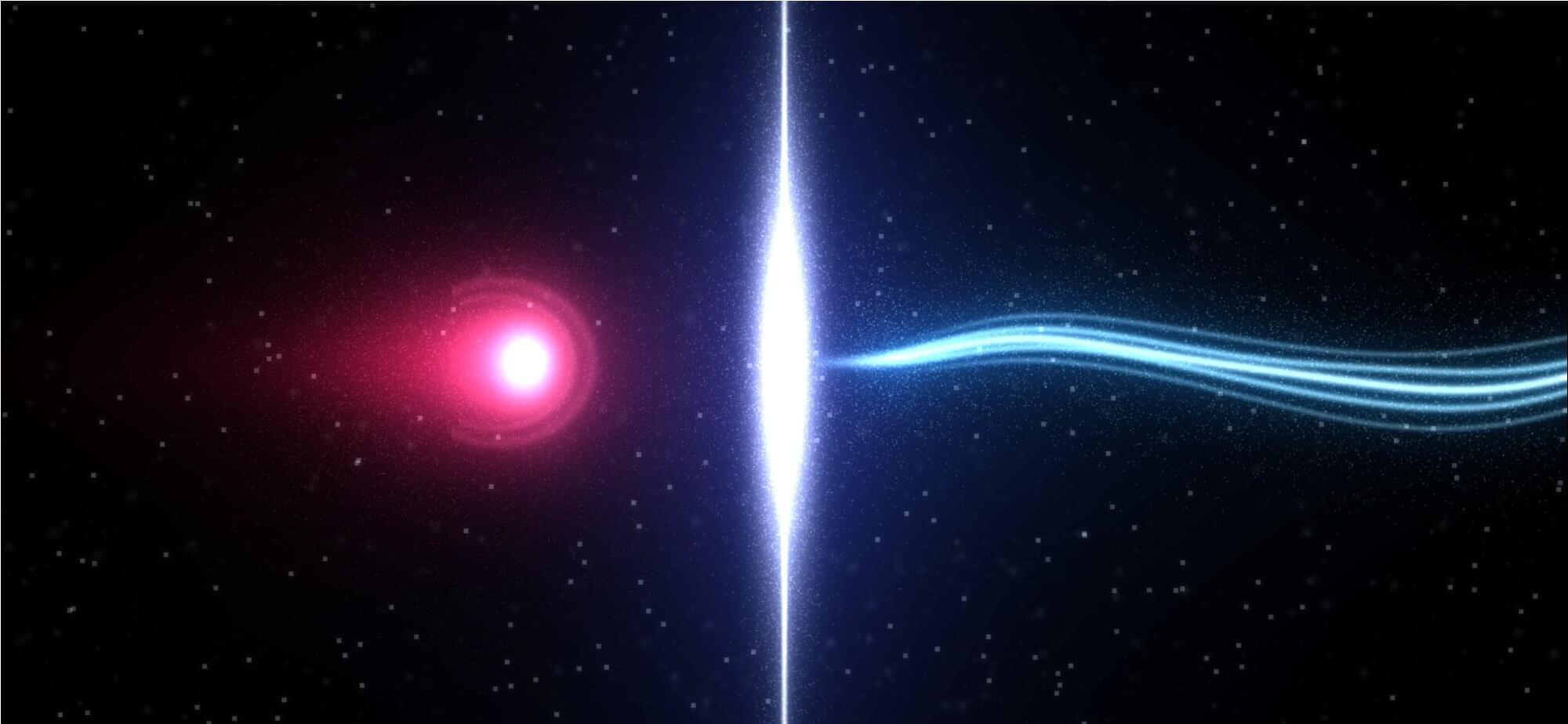
Throwing quantum wave packets at a so-called “duality defect”—an interface stitching together two quantum worlds that are secretly descriptions of the same physics—they find that the particle is never reflected: it always passes through, with 100% probability, and reemerges as precisely what the father promised. A wisp of fog: faint, smeared out, trailing an invisible thread of quantum mist back to the mirror’s edge.