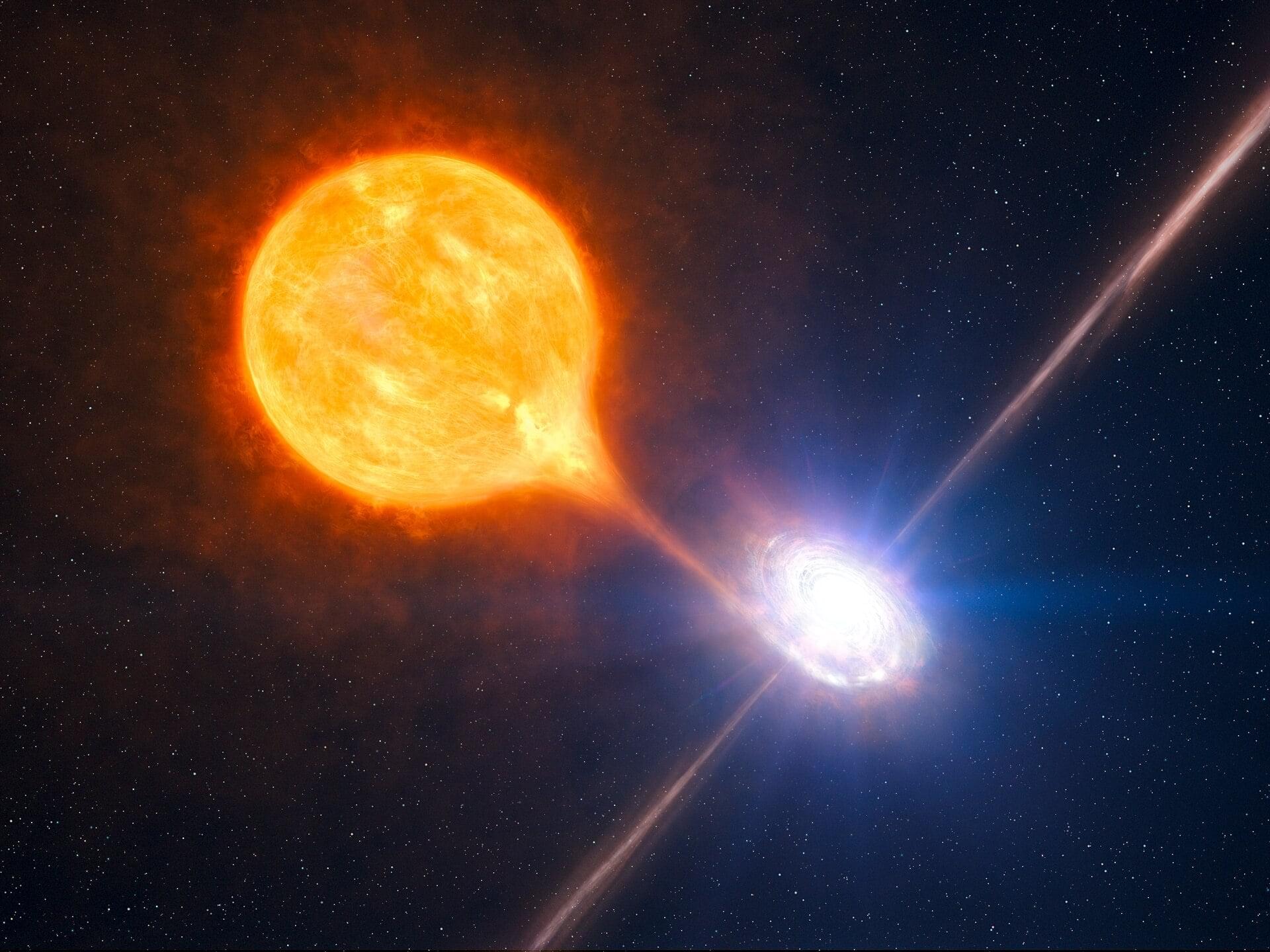
Black holes represent some of the most extreme environments in the universe. They are the sources of the strongest gravitational fields, allowing us to test Einstein’s theory of general relativity to an extent impossible with small objects. But we are also reaching the limit of what we can learn about one remotely. So, various authors have put forward ideas for how we might eventually send a probe directly to a black hole to observe it up close. One of the most vocal of those authors is Cosimo Bambi of Fudan University in Shanghai—and he recently released a paper, available as a preprint on arXiv, about what it would take to send a gram-sized probe to a nearby black hole.
Unfortunately, we do not know of any “nearby” ones—at least not yet. The closest known black hole is Gaia BH1, which is roughly 1,560 light-years away in the constellation Ophiuchus. However, we only know Gaia BH1’s position because it has a slight gravitational pull on a nearby companion star. There are likely many more invisible black holes in our galactic neighborhood that do not have such telltale signs.
According to the paper, the Milky Way likely contains about 100 million stellar-mass black holes. That is not a typo—there are most likely hundreds of millions of black holes the size of a star floating around our galaxy. Crucially, 92% of them are isolated, without a companion star to illuminate them—meaning they would be essentially invisible because they suck up all the light directed their way. But, according to Bambi’s paper, there should be one stellar-mass black hole for roughly every 1,500 cubic parsecs (about 52,000 cubic light-years)—keep in mind that the Milky Way has an estimated volume of 150 cubic kiloparsecs.