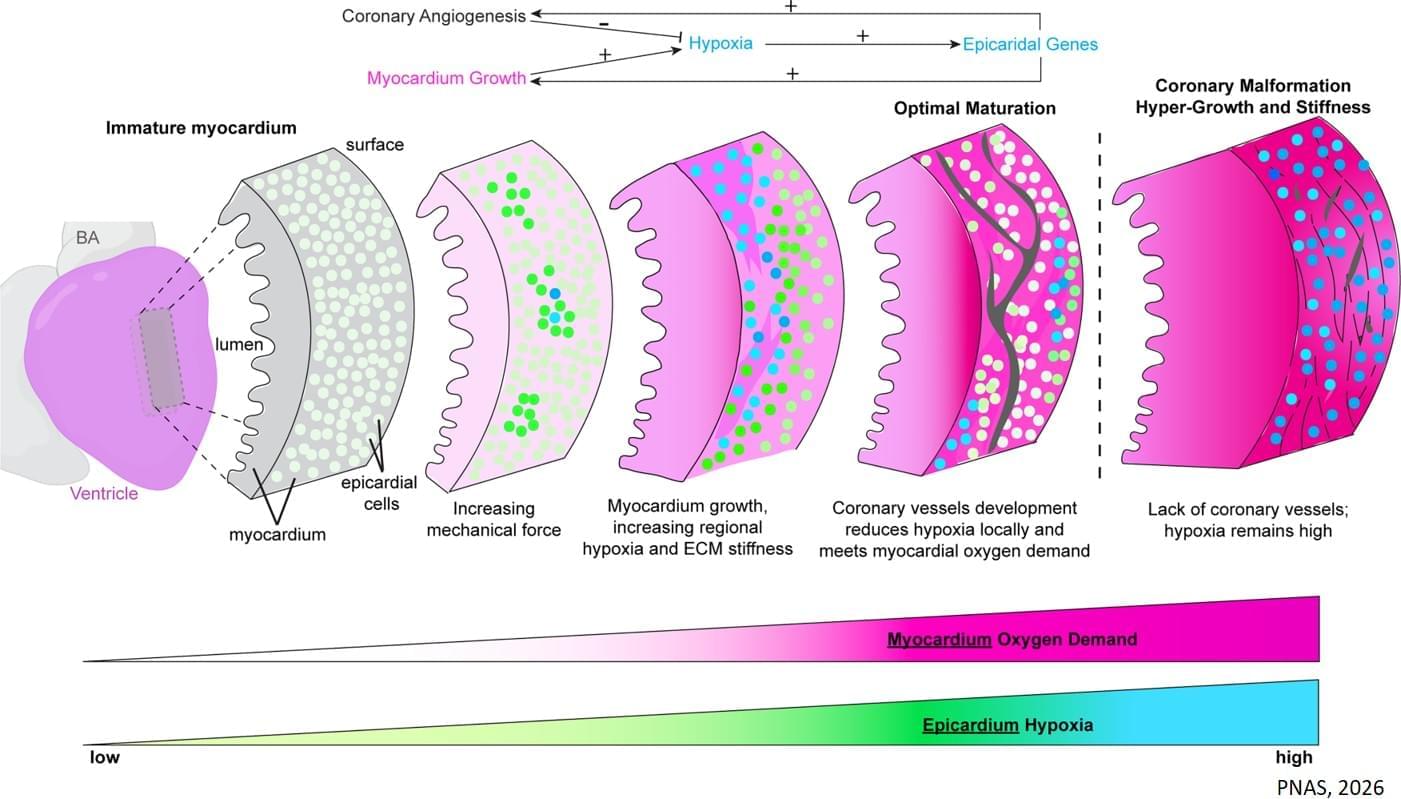
During development, regional dips in oxygen levels serve as a signal that triggers the coordinated growth of heart muscle and coronary vessels, according to a new study. The findings, published in the Proceedings of the National Academy of Sciences, could point toward innovative approaches for treating cardiovascular conditions that lead to heart failure.
“The signaling pathways that direct the development of this remarkable organ are also affected in pathological conditions,” said the senior author. “Interventions that target these signals or the cells that produce them could potentially change the trajectory of disease or slow its progression.”
One of the biggest mysteries was: what drives their growth—and how is that expansion synchronized with that of the muscle tissue they serve? “Initially we thought that there would be direct crosstalk between the two,” the author said. Either the muscle secretes signals that attract developing vessels—or the vessels produce signals that promote muscle growth.