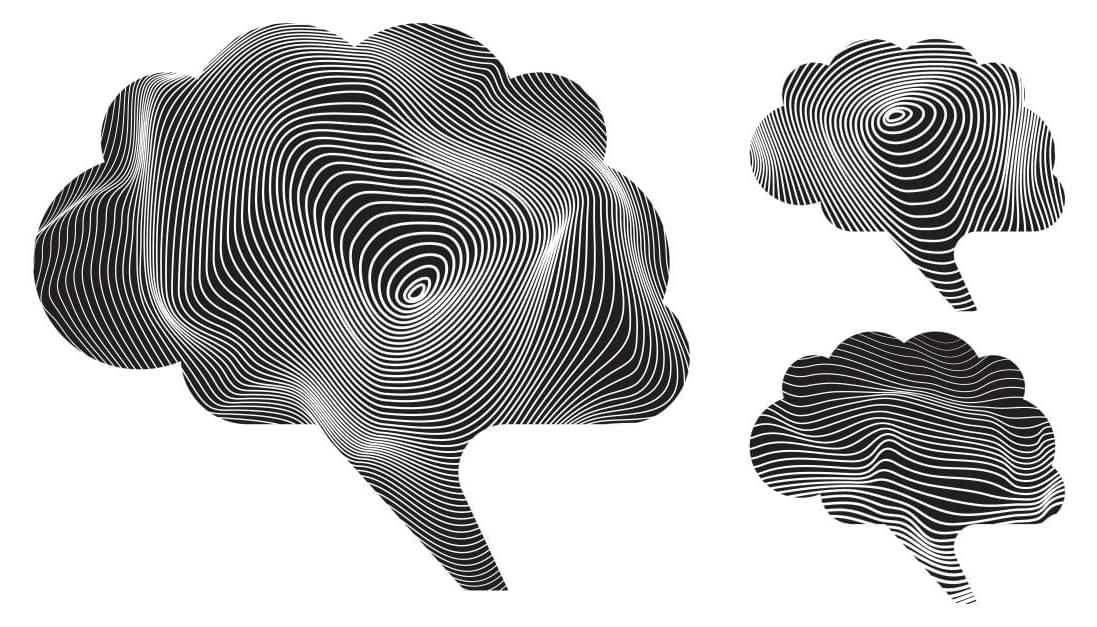
A new theory from neuroscientists at MIT’s Picower Institute proposes that cognition and consciousness may depend not only on neurons and synaptic connections, but also on the traveling electrical waves generated by neural activity.
The traditional “brain as circuitry” analogy captures an important part of neuroscience: synaptic connections store and transmit information. But Earl Miller and colleagues argue that synapses alone may be too slow and inflexible to explain how the brain rapidly assembles and reorganizes neural networks from moment to moment.
Their proposal centers on brain waves as a dynamic control system.
Slower alpha and beta oscillations, associated with internal information such as memories, goals and expectations, may regulate faster gamma activity associated with incoming sensory information. Because these waves can travel across the cortex, they could rapidly determine which populations of neurons participate in processing at a particular place and time.
The researchers describe this as “spatiotemporal computing.” Where electrical waves interact, their amplitudes can add or subtract, potentially allowing the brain to perform a form of analog computation through wave interference rather than relying entirely on sequential, digital-like operations.
The theory also incorporates ephaptic coupling—the possibility that electrical fields generated by populations of neurons can directly influence the firing of nearby neurons, providing another rapid mechanism for coordinating neural activity.
The authors extend the idea to consciousness, proposing that conscious awareness emerges when these wave dynamics organize widespread cortical activity into a coherent, globally integrated state. Supporting evidence includes anesthesia research showing that drugs with very different molecular mechanisms can all produce unconsciousness while disrupting large-scale brain-wave organization.
Importantly, this remains a testable theory, not a settled explanation of consciousness. Miller notes that the next major step is to look for direct signatures showing that these wave interactions are actually performing the proposed analog computations.
If supported, the framework would suggest that brain waves are not merely byproducts or correlates of neural processing—they may be an integral part of how the brain computes, coordinates information and generates conscious experience.
The brain’s ability to generate quick, nimble volitional thought—and a unified awareness of thought and experience—arises from analog computations carried out by electrical waves, MIT neuroscientists argue in a new review.