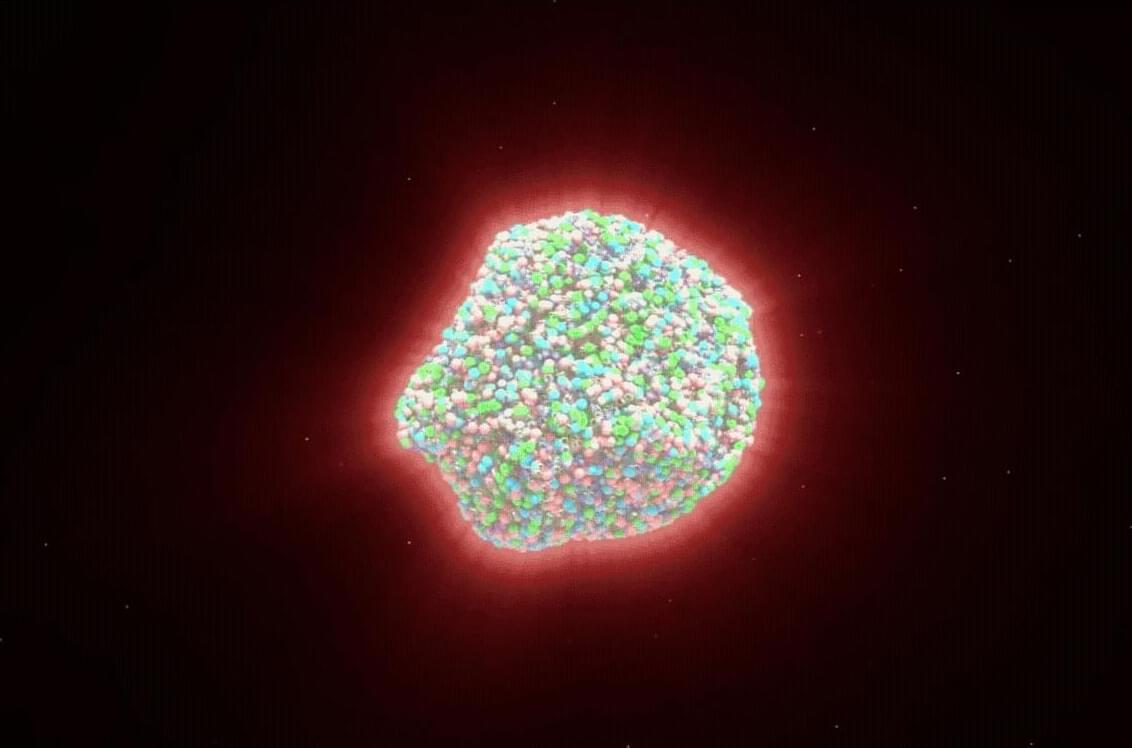
All four major LHC experiments have found new evidence that collisions between oxygen and neon may produce the extreme state of matter that existed during the first microseconds after the Big Bang.
Inside the Large Hadron Collider (LHC), collisions between relatively light oxygen and neon nuclei may be producing matter from the earliest moments of the Universe. One year after the collider’s first oxygen runs, all four major LHC experiments, ALICE, ATLAS, CMS, and LHCb, have reported signs of quark–gluon plasma (QGP).
QGP forms under immense pressure at temperatures more than 100,000 times hotter than the center of the Sun. In these conditions, composite particles break apart into quarks and the gluons that normally bind them together. This state of matter is thought to have filled the Universe during the first millionths of a second after the Big Bang. Nearly 14 billion years later, physicists can briefly recreate it through high-energy nuclear collisions at the LHC.