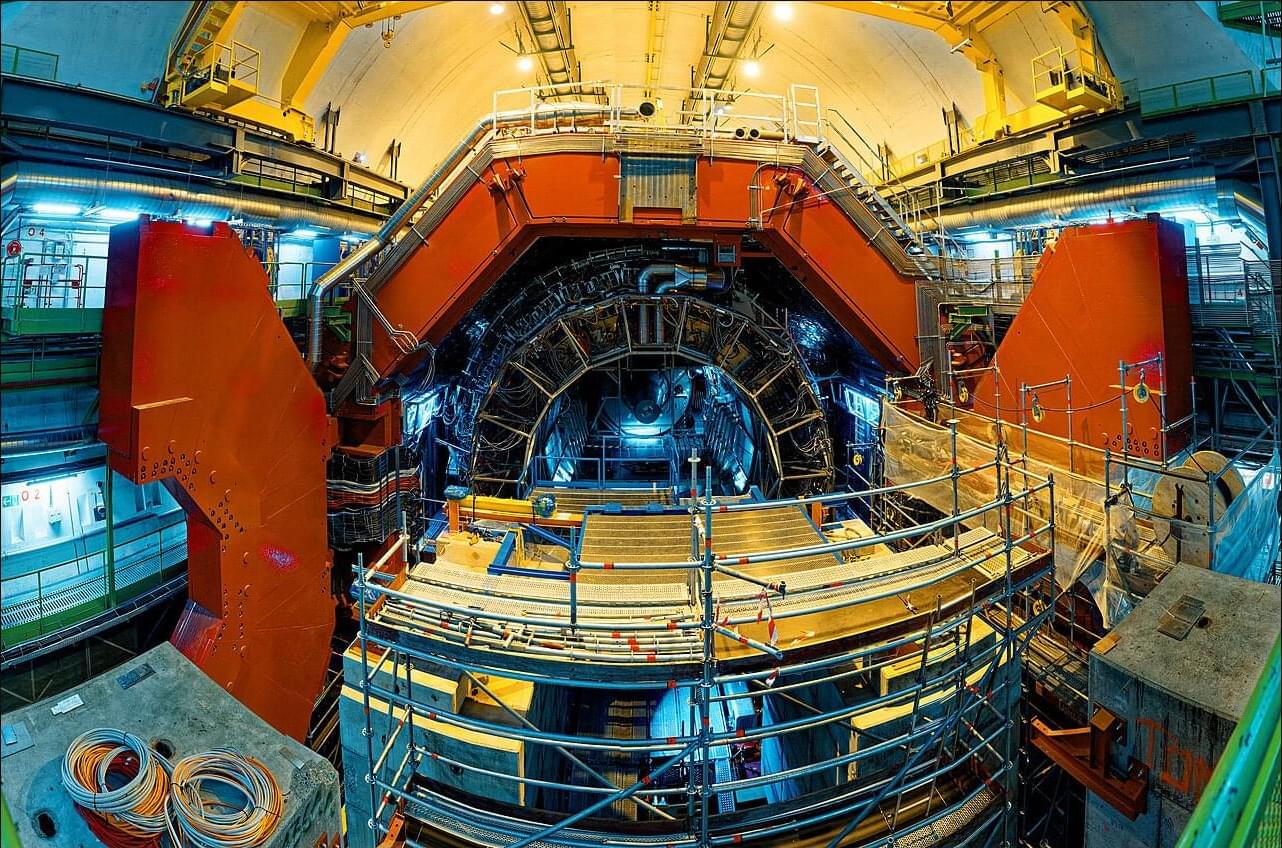
ALICE measurements suggest that gluons inside nuclei begin behaving collectively at very small scales, favoring gluon saturation over conventional nuclear shadowing alone.
Deep inside atomic nuclei, gluons bind quarks together and help determine the structure of visible matter. A CERN study, with a University of Kansas physicist playing a leading role, has now shown that experiments can distinguish between two competing explanations for how these particles behave in nuclei.
Conducted with the ALICE experiment at CERN’s Large Hadron Collider and published in Physical Review Letters, the research provides the first multidimensional measurement of incoherent J/ψ (pronounced “” JAY-sigh”) photonuclear production across both interaction energy and momentum transfer. The approach gives researchers an unusually detailed picture of how gluons are distributed inside atomic nuclei at high energies.