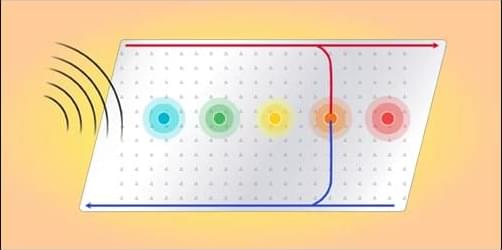
Two experiments demonstrate a promising platform for trapping, sorting, and directing vibrational energy.
In a rainbow, sunlight separates into colors because each wavelength of light follows a different path. This familiar image has inspired an analogous idea in wave physics: A designed material can slow down different frequency components of a broadband signal at different positions, thereby sorting the signal in space. This concept, known as rainbow trapping, was introduced as a route to storing light in metamaterials [1] and has since motivated efforts to control sound, vibration, and other classical waves. But rainbow trapping has been difficult to realize for elastic waves—vibrations that temporarily deform a material as they move through it. Many rainbow designs have relied on vibrational modes confined to a sample’s edges or interfaces, limiting the available trapping area, or have lacked a way to access and route energy once it has been localized.
Now two teams have taken complementary steps toward overcoming these limitations. Yafeng Chen at Tongji University in China and colleagues have created and directly visualized an elastic rainbow in which different megahertz-frequency vibrations stop at different positions [2]. Meanwhile, Riyi Zheng at the South China University of Technology and colleagues have shown that a similar rainbow can be captured and redirected using topological edge states [3]. Together, these two studies transform elastic rainbow trapping into a platform for sorting, confining, and guiding vibrational energy.