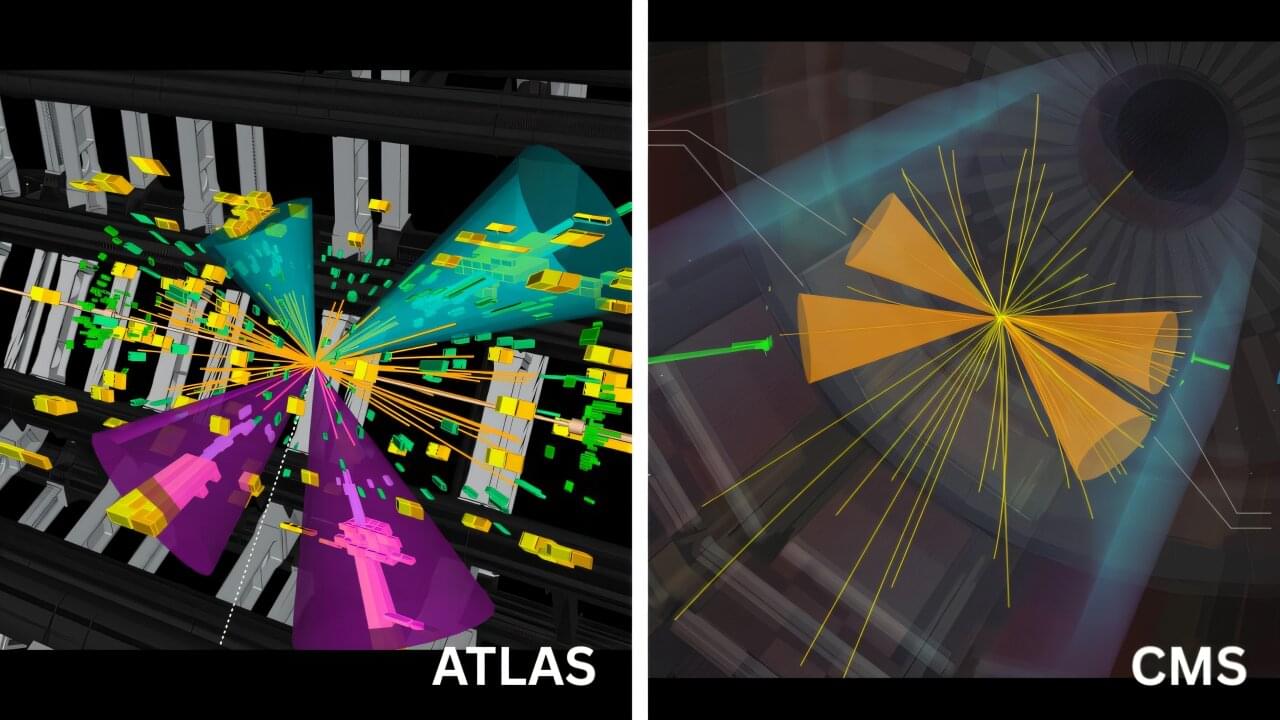
Finding one Higgs boson was hard enough, but physicists at the Large Hadron Collider (LHC) are hunting for something even more elusive: pairs of Higgs bosons. At the recent International Conference on High Energy Physics 2026, the ATLAS and CMS collaborations presented new constraints on the double-Higgs production rate, providing insight into how the Higgs boson interacts with itself.
The discovery of the Higgs boson in 2012 at the LHC marked the beginning of a new era in particle physics. Since then, researchers at the LHC have investigated and measured how the Higgs boson interacts with other particles, an important mechanism by which these particles get their mass.
However, physicists have yet to observe the Higgs boson interact with itself. Understanding this process would not only test the limits of the Standard Model, our current best working theory for particle physics, but also help shed light on whether the vacuum of our universe is stable.