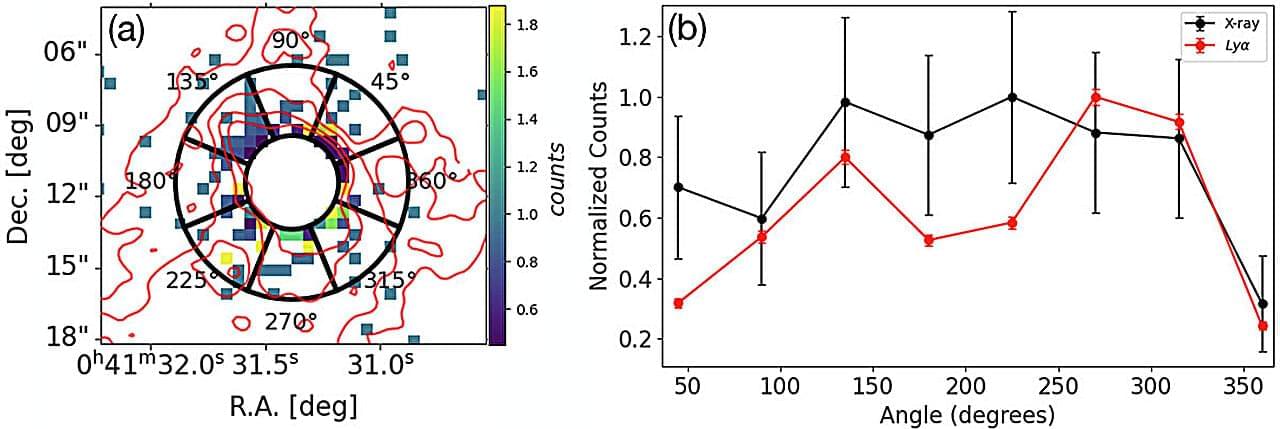
Astronomers have detected an enormous cloud of gas tens of millions of degrees hot surrounding one of the most extreme structures known in the early universe. The study offers one of the clearest views yet of a galaxy cluster in the making. Using more than 600,000 seconds of observations with NASA’s Chandra X-ray Observatory, the team found diffuse, extended X-ray emission around a quasar embedded in a dense concentration of galaxies more than 11 billion light-years away. The paper describing the results was published in Astronomy & Astrophysics on July 24.
Thousands of galaxies gravitationally bound together in a crowded region are collectively called a galaxy cluster. They can form through gravitational collapse and mergers with smaller structures. When gas is accreted into a reservoir of hot gas—the intracluster medium (ICM)—that fills the gaps between galaxies in a cluster, the infalling gas undergoes shock heating, reaching temperatures of tens to hundreds of millions of Kelvin. The hot gas is primarily detected through X-ray emission.
Astronomers understand this hot gas well in mature, nearby clusters. But they want to know when and how this hot gas envelope first started forming, when the universe was young.