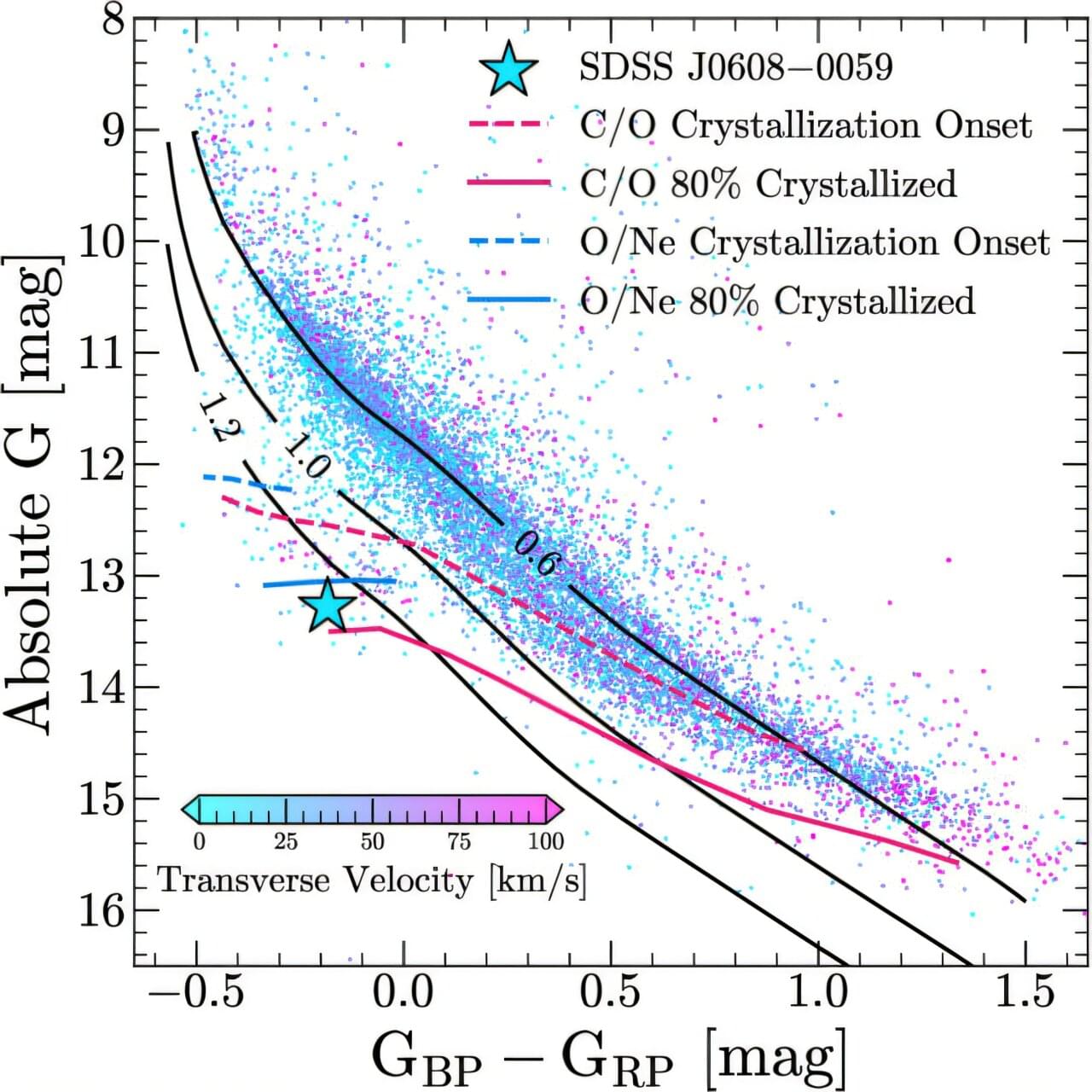
Astronomers have found evidence that one of the most massive white dwarfs known has an oxygen-neon core instead of the more common carbon-oxygen core. The finding is important because the composition of a white dwarf’s core determines how it will evolve. A paper outlining this discovery was published in The Astrophysical Journal.
Typically, white dwarfs have a mass of 0.5–0.7 times the sun’s mass. Such objects have a core made up mainly of carbon and oxygen (C/O core). When they have stellar companions, these dense objects can accumulate matter from them and eventually produce a Type Ia supernova. Ultramassive white dwarfs, with masses above roughly 1.05–1.1 times the sun’s mass, tell a different story that is not yet fully understood.
These more massive white dwarfs are thought to form from “ancestor” or progenitor stars in the range of about 8–10 times the sun’s mass. In these heavier progenitors, the core reaches higher temperatures and densities, allowing carbon to ignite and fuse further into oxygen and neon (O/Ne core). This does not happen in the cores of lower-mass stars, which stop fusing once they have built up carbon and oxygen, lacking the required core temperatures.