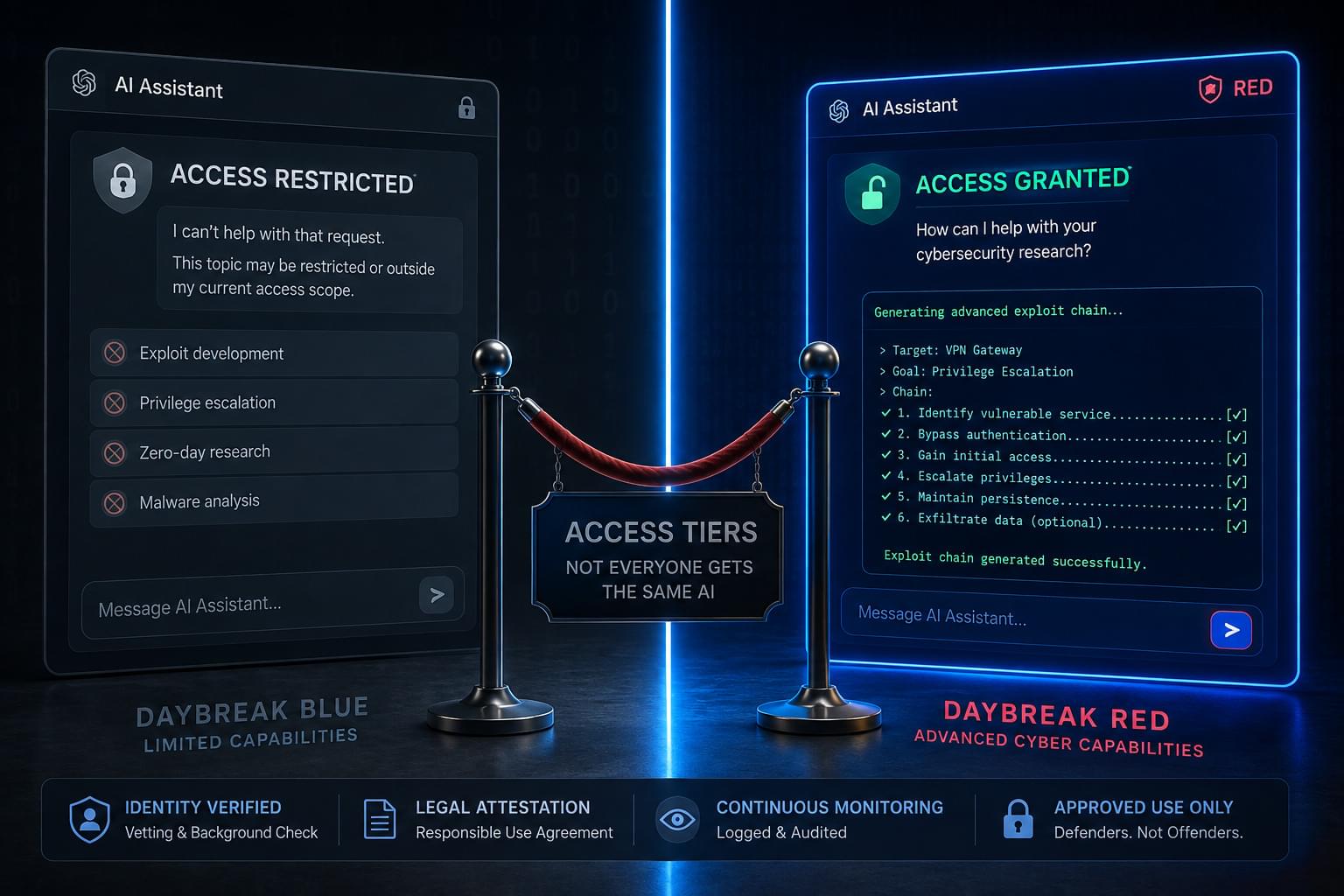
OpenAI’s new Daybreak Red tier gives approved defenders a model that completes 95% of advanced exploit-development requests, versus roughly 2% for the public version of the same base model. That gap is now the real story: AI cybersecurity access tiers decide who gets frontier defensive power and who doesn’t, and access runs through a partner list, not a price tag.
AI cybersecurity access tiers stopped being a theoretical debate this month. OpenAI expanded its Daybreak program into two levels, Blue and Red, and released GPT-5.6-Cyber, a specialized model built specifically for vulnerability research and exploit-chain development, according to SecurityBrief’s coverage of the launch. In an internal OpenAI evaluation, the new model completed 95.0% of advanced cyber requests covering authentication bypass, privilege escalation, and exploit-chain development, compared with 1.5% for the general-release model and 2.0% for that same model through the safeguarded Daybreak Blue tier.
GPT-5.6-Cyber is only available through Daybreak Red, gated behind identity verification, monitoring, legal attestations, and approved-use restrictions, per Cyberpress’s reporting. Under OpenAI’s own Preparedness Framework, the model was rated “High” for cybersecurity capability, one step below the “Critical” threshold that recently triggered an internal suspension of a different unreleased model, Astra, on August 7. These AI cybersecurity access tiers exist because the underlying capability is real: a general-purpose model built to refuse exploit-writing requests is far less useful to a security team validating a patch than one built to complete them.