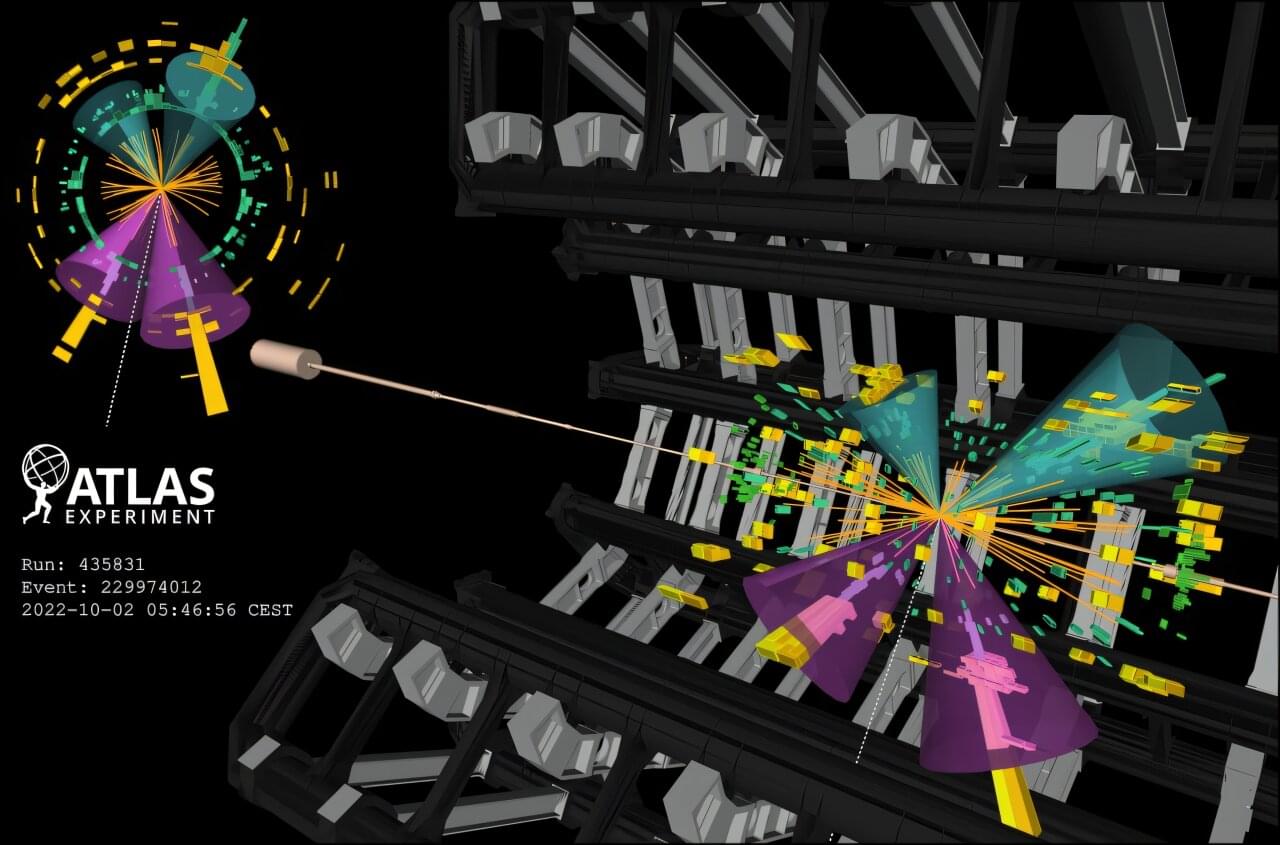
Is the universe as stable as we think it is? That’s one of the big questions that particle physicists worldwide are preparing to answer with the Large Hadron Collider, or LHC—the world’s most powerful particle accelerator—when its upgrade is completed in about four years. In the meantime, researchers, including a cohort at the University of Michigan, are working to sharpen their analytical tools and techniques to make the most of the LHC’s current and future data.
A team including U-M physicists has now reported record-setting sensitivity in spotting a specific interaction within the LHC’s data that may help answer fundamental questions about our universe. In particular, the analysis uses an advanced AI algorithm to spot signatures researchers are looking for to understand how the Higgs boson, the famous fundamental particle that helps explain how subatomic particles have mass, interacts with itself.
“This analysis is the most sensitive in the world to this specific physics,” said Greg Myers, a research fellow in the U-M Department of Physics.