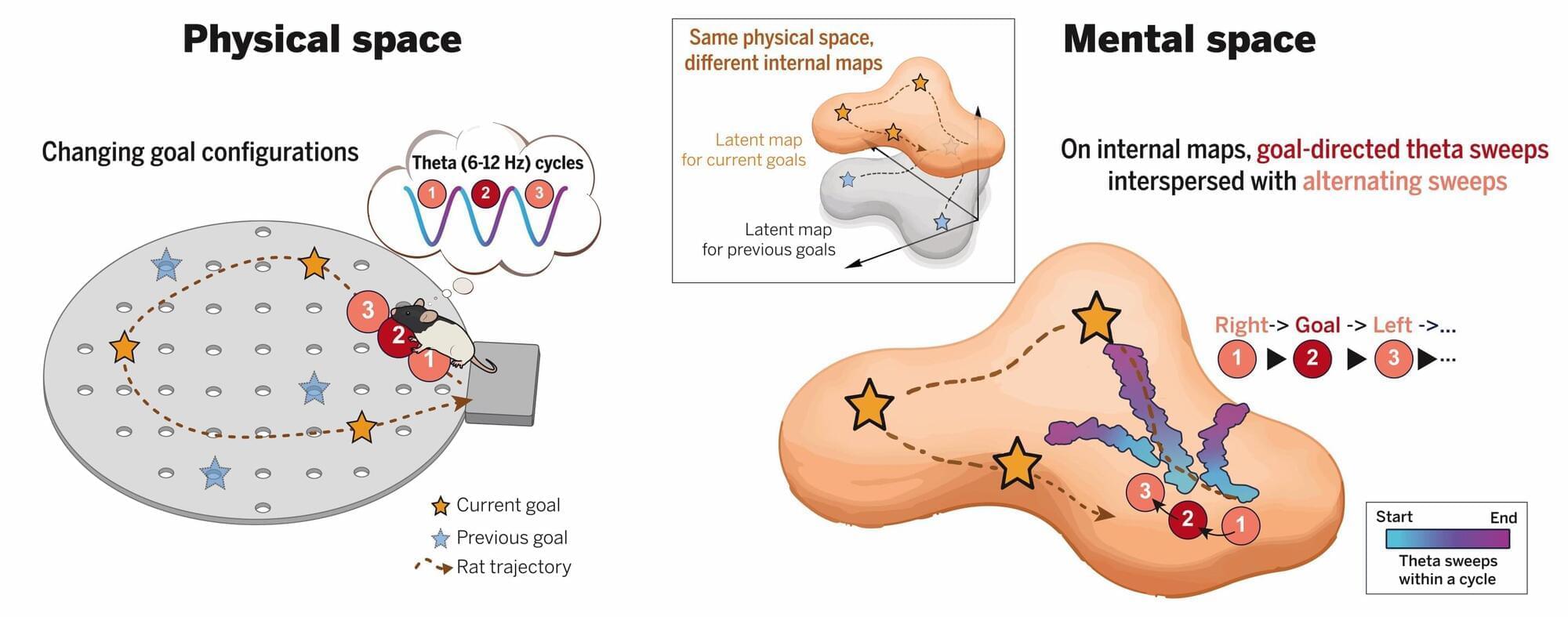
When humans and other animals move through familiar or unfamiliar environments, their brains rely on numerous intricate neural processes to decide which path to take next. Past studies have identified a specific population of cells in the hippocampus, a structure deep within the brain, that appears to play a key role in spatial navigation.
These cells, called place cells, become active when an animal either visits or thinks about a specific location. Place cells often fire in rapid sequences during so-called theta oscillations (i.e., rhythmic brain activity patterns that cycle approximately 4–12 times per second). These rapid bursts of sequential place cell activity, also known as theta sweeps, were previously associated with the mental evaluation of possible future routes.
Two distinct research teams based at Cornell University and University College London recently shed new light on the contribution of theta sweeps to spatial navigation.